Showing posts with label craig baldwin. Show all posts

2016/02/06

Interview with Evie Salmon in Otherzine


Otherzine, the underground film magazine based out of San Francisco's great Other Cinema, have just published their 30th edition. It’s been issued to coincide with Other Cinema's 2016 Spring Programme. Edited by Molly Hankwitz, Otherzine 30: M a T e R i A L Cinema

[…] explores the material processes of film making, whether digital or analogue, small-screen, handmade or multiplex; performed, or projected, performed and projected, historical or recent. We are especially proud of this wonderful and enigmatic collection; clever, individual pieces each a producing a thoughtful glance at or analyzing some component of “materiality” with a very  strong emphasis, as it turns out, upon “live” cinema performance, and the performance of cinema.

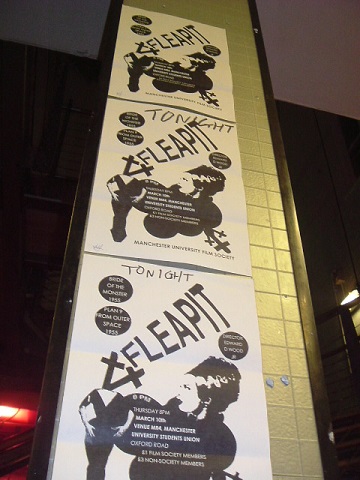
fleapitposters
Fleapit: Somewhere in the North
I’m happy to say that I’ve been included in this issue. The brilliant Evie Salmon graciously took some time out to interview me about Fleapit and the Road Movies project. As you’ll see from the text, because she’s been there since the start, Evie is ideally placed to ask the right kind of questions from the right kind of angle. It was a real pleasure to revisit the very earliest Fleapit shows in this interview which Evie expertly edited from a much longer conversation. Her introduction gets it bang on: shambolic shows, dodgy cowboy boots, disinterested crowds. The battlefield she describes was a brief foray I undertook to Edinburgh just as Fleapit was starting out in Lancaster. An additional point of circularity comes with the link to Other Cinema. Craig Baldwin’s work was a massive influence on Fleapit and continues to inform my thinking on film more generally. As such, it’s a great pleasure to now have the project covered in Otherzine


You can read the issue here. To go to the interview direct, click here

2014/07/03

Occult, Magick, Evil and the Powers of Horror

The new issue of One+One is out and you can read it here. It's a special edition covering 'Occult, Magick, Evil and the Powers of Horror'. I have two articles included, one on projection and Night of the Demon, the other on Craig Baldwin and his film Mock-Up on Mu. Mark Goodall also has an article on Mario Mercier which is well worth checking out.....

Many thanks to James Marcus Tucker, Bradley Tuck and the rest of the One+One team for pulling this issue together.....

2013/09/09

LA X-Ray

Roger Corman’s X: The Man with the X-Ray Eyes (1963) has had a strange afterlife. It’s not as popular as The Little Shop of Horrors (1960) or Corman’s Poesploitation oeuvre, but for sheer hallucinatory energy it’s certainly a lot better than his overrated LSD movie The Trip (1967). Corman says more about his other films in How I Made a Hundred Movies in Hollywood (1998) but X has nevertheless persisted as a “cult creepie” not least because of its appropriation by contemporary film-makers particularly Amanda Beech and Craig Baldwin.

X ostensibly keys into all the comic-book phantasies promised by 25-cent x-ray specs. Ray Milland stars as James Xavier, the archetypal scientific over-reacher who, frustrated with his limited perception of the wave spectrum, self-administers the experimental Compound X. This grants him the power to see through walls and clothes as well as the ability to assess and intervene in risky surgical practices. So far, so good – nothing particularly interesting here. However, once Xavier realises that Compound X is cumulative in its effects, the film takes on an unexpected level of proto-psychedelic intensity. He’s robbed of darkness, sleep, shelter from the glare of the sun until finally, wandering in the desert on the outer limits of Las Vegas, he confronts the terminal horror of the universe fully revealed.

X belongs to Corman’s subset of nihilistic, eschatological movies, films like The Day the World Ended (1955) and The Last Woman on Earth (1960). Whereas films like It Conquered the World (1956) mirror the paranoia of Invasion of the Body Snatchers (1956), these films are full of Cold war fear and loathing: not the anxiety that something awful might happen, but the dread and ennui that comes with having living through the actuality of such a disaster. Although X doesn’t take place on a ruined Earth, it nonetheless plots a (literally) post-apocalyptic scenario because it shows the immolating consequences that follow a moment of intense revelation.

Part of what makes X interesting is its reliance on the structure of the road movie. Xavier moves from downtown LA to the wastelands of the desert; from urban rationality to the hysteria of an evangelical tent-meeting and his final epiphany. Along the way he sees Los Angeles as an x-rayed accumulation of skeletal architecture, a “city unborn, with its skin dissolved in an acid of light […] a city of the dead”.

That Xavier is able to perceive the scaffold that underpins the svelte exterior of Los Angeles and later, Las Vegas, gives his x-ray vision a critical trajectory. At the start of the film, Xavier’s exploration of the wave spectrum is epistemological. It provides a means of discovery as regards the spaces that carry sedimentary content. Walls are seen to enclose rooms that hold private dramas and clothes cover bodies that carry organs held in place by skeletons. By the time of his urban excursions, Xavier’s insight has become ontological. He is able to see that which constitutes the material – and in the film’s closing moments the phenomenological – fabric of ‘reality’. His view of LA as the “unborn” city “rising in the sky” full of “signs without supports” announces a paradigmatic shift in the trajectory of his vision. An awareness of architectural and corporeal dissimulation gives rise to a perception of these surfaces as simulations, membranes of false plenitude that cover abysmal vacancy.

Beech draws on this aspect of X in her multi-platform work Sanity Assassin (2010). Commissioned by Spike Island in Bristol, Sanity Assassin is a three-channel video installation that incorporates a “sculptural [1] element: a spotlit mirrored plinth which displays a series of polished chainsaws situated in a custom-designed waiting area”.

The ‘showroom’ is based on the premises of the McCulloch chainsaw company in LA and the parallel video depicts a series of cityscape scenes cut to a noise soundtrack and a draconian editing rhythm.

Sanity Assassin offers Los Angeles as a geographical ossification of the neo-liberal agenda. Reality is presented a particularly violent form of hegemonic realism whereby space, policy and capital maintain dominance (despite inefficiency) through the projection of freedom and security as non-contradictory utopian ideals. Mike Davis offered a similar critique of LA’s political architecture in City of Quartz (1990) in which he analysed such late-capitalist symptoms as the city’s ‘fortress’ aesthetic and its gentrifying public transport facilities.[2] By contrast, Beech’s work draws this critical identification of postmodern irony into its analysis. Sanity Assassin works to interrogate the process of critique. Her study of LA operates as part of a wider investigative field in which the humanistic bias of critical theory is positioned as an agent in the production of the politics it seeks to question: “exposing power and making it visible simply reminds us that power exists as such”.[3] In the light of this position, Sanity Assassin takes as its representational modus operandi the contingency of power:

The work explores the various contradictions that are produced as a consequence of theorizing how to act when there is no absolute power to target and no centre from which to operate. Most particularly, the work attempted to explore the aestheticization and theorization of this infinitude as the real of the political and how it informs and shapes politics.[4]

In Sanity Assassin, the book that accompanies the installation, Beech includes a series of research images that informed the composition of the work. Amongst this montage of interiors and monoliths there’s a small still of Milland as Xavier taken from the closing moments of Corman’s film. Gazing with obsidian eyes into the agony of the revealed void, attempting to comprehend “the eye that watches us all”, Xavier exemplifies Beech’s project. As Marie-Anne McQuay suggests, the “horrific consequences” of Xavier’s “collision with the Real” signpost the trajectory of the project towards the interrogation and removal of the anthropomorphic subject in the work of critique.[5] By aligning Xavier’s vision with the Real, “the umbilical cord of the symbolic”[6], the subject of his gaze is recast not as that which is ‘beneath’ or ‘beyond’ but that which is negative; the sense of difference rather than correspondence that normative perceptions work to exclude. What the film couches in terms of sin and transgression is presented in Sanity Assassin as momentary proximity with the kind of conceptual heat that closes Robert Aldrich’s Kiss Me Deadly (1955).

The oscillation in X between the physical and the metaphysical evokes the “cult stratum” that Davis highlights in the rise of Southern California as a science state. From the mid-1920s, the California Institute of Technology in Pasadena played host to a rolling faculty of pioneering scientists who helped to establish “an emergent techno-structure” that fueled a post-war science based economy.[7] However, in the case of John ‘Jack’ Whiteside Parsons, this intellectual labour intersected with a dense matrix of seemingly dissonant interests. 

Parsons was a key influence in the establishment of the Pasadena Jet propulsion Laboratory and contributed to the development of solid rocket fuel. He was also a student of the occult and in 1942, under the guidance of Aleister Crowley, he assumed leadership of the Agape Lodge of the Ordo Templi Orientis (OTO). In addition, he was a member of the Los Angeles Fantasy and Science Fiction Society where he met Robert Heinlein and L. Ron Hubbard. His association with Heinlein gave the latter important pointers for Stranger in a Strange Land (1961) whilst his ill-fated connection to Hubbard arguably informed the “amalgamation of black magic, psychotherapy and science fiction” that Hubbard peddled as Scientology.[8]

In Davis’ discussion, this web of connections that move across the “vast wheel of public-private research” represent “bizarre” detours in the otherwise “seamless continuum between the corporation, laboratory and classroom” that characterised the economic rise of post-war Southern California. Certainly in the case of the ascent of Dianetics and Scientology, the persistence of this distant Cal-Tech offspring exists as a “discouraging reminder of science’s fate in the local culture”.[9]  For San-Franciscan film-maker Craig Baldwinthis web is not a historical aberration but is instead representative of the actual matter of Southern California. The “local culture” is entirely constituted of these spirals of conspiracy, post-war science, espionage and ‘trash’ aesthetics.

In his film, Mock-Up on Mu (2008) Baldwin embarks upon a similar excavation of Southern California’s Mock-Up on Mu is a speculative analysis of the biographical intersections that existed between L.Ron Hubbard, Aleister Crowley, Jack Parsons, Marjorie Cameron and Lockheed Martin. In essence, this group symbolises the same triangle of culture, science and industry central to Davis’ analysis. However, Baldwin’s collage approach – the creation of a ‘documentary’ using clips from obscure b-movies and ‘found footage’ – seeks not to pull away the veils of myth in order to foreground ‘truth’ but instead exaggerates the imaginary lives of the characters as a means to analyse the construction of the myth.
future as that performed by Davis, but rather than analysing the concrete terrain of significant structures, he explores the imaginary environment of genre cinema and mythopoesis.

Within this approach, X plays a small but significant role. Corman’s film is one of the many that Baldwin absorbs into his cut-up network that structures the film. In Chapter 11, ‘Desert Crossings: A fugitive Parsons sets off a manhunt’, we see Parsons, (played by Kal Spelletich) fleeing across the desert having been shot by Lockheed Martin (Stoney Burke) as part of a wider Hubbard engineered plot to gain control of a solar energy device. Parsons’ flight is inter-cut with that of Cary Grant in North by Northwest (1959) and Milland in X. Over the top of this montage Baldwin adds a voice-over that reads from Parsons’ essay ‘Freedom is a Two-Edged Sword’ (1950): 

The inertia and acquiescence which allows the suspension of our liberties would once have been unthinkable. The present ignorance and indifference is appalling. The little that is worthwhile in our civilization and culture is made possible by the few who are capable of creative thinking and independent action, grudgingly assisted by the rest. When the majority of men surrender their freedom, barbarism is near but when the creative minority surrender it, the Dark Age has arrived. Even the word liberalism has now become a front for a new social form of Christian morality. Science, that was going to save the world back in H.G. Wells' time, is regimented, straitjacketed and scared; its universal language is diminished to one word, security.[10]

‘Freedom’ is essentially a libertarian tract that posits the concept as the product of self-ultimacy, whereby the exertion of the individual will can help cultivate the appropriate territory in which “man” can live. However, in the quote above its hard not to see some echoes of Beech’s project. Putting aside the implied desire for an Ayn Randian creative oligarchy, the connection of “liberalism” with the restrictions of “security” evokes the critique of neo-liberalism and the security state in Sanity Assassin.

Baldwin’s use of X is also similar. Ostensibly the montage seeks to equate Parsons’ near death pursuit of a Temporary Autonomous Zone with the transcendent vision of Xavier. Both appear to willfully strive for an apprehension of a space or entity that lies beyond normative limits. However, this Nietzschean individualism is subverted through the proliferation that Baldwin creates via the application of his assemblage technique. Despite the self-assertion of Parsons’ words, at the level of the image, ‘Parsons’ is a fluid persona, one the drifts from the actor Spelletich to any number of substitutes: Milland, Grant and elsewhere in the film Kris Kristopherson and Hugh Marlowe The character thus holds no stable subjectivity. Instead, there is only a strange kind of dub identity, one that constantly navigates the length of a wave spectrum from reconstructive performance to speculative association. If X represents the horror of the LA Real in Sanity Assassin, in the matrix of Mock-Up on Mu, the stroboscopic expanse that forms the narrative of Corman’s film offers a complimentary metaphor. Baldwin’s conspiratorial web gives no glimpse of an occulted ‘reality’ but offers the networks of conspiracy as the Real that informs the symbolic structure of his obsessive characters.  


[1] Marie-Anne McQuay,‘Introduction’ in Sanity Assassin (Falmouth: Urbanomic, 2010), pp. 7-11 (p.7).
[2] Mike Davis, City of Quartz: Excavating the Future in Los Angeles (London: Verso, 1990), pp.223-263.
[3] Amanda Beech and Jaspar Joseph-Lester, ‘Reason Without Reason’, in Sanity Assassin, p.92.
[4] Ibid.
[5] Beech, p.66; McQuay, p. 8.
[6] Alan Sheridan in Jacques Lacan, The Four Fundamental Concepts of Psychoanalysis, (Harmondsworth: Penguin, 1973), p. 279.
[7] Davis, p. 59.
[8] Ibid, p.60.
[9] Ibid.
[10] John Whiteside Parsons, ‘Freedom Is a Two Edged Sword’ in Freedom Is a Two Edged Sword and Other Essays (USA: New Falcon, 2001).

2011/11/20

Craig Baldwin


Great video clip from a short film profile of Craig Baldwin (See 'Archive Fever' elsewhere on this blog).


2010/08/27

Archive Fever


In his classic 1951 essay ‘As in a Wood’, Andre Breton describes the value of cinema lying ‘in its power to disorient’. This effect is linked not to the content or ‘merits of a given film’ but in the viewing experience offered to the spectator by the spatial organization of the cinema building. The movement into the darkness of the auditorium is seen as a passage ‘through a critical point as captivating and imperceptible as that uniting waking and sleeping’. Breton states that this sense of disorientation can be intensified into a ‘magnetising’ experience through a nomadic transition between various film screenings, ‘dropping into the cinema when whatever was playing was playing, at any point in the show, and leaving at the first hint of boredom – of surfeit- to rush off to another cinema’.(A) Much has been written concerning the attempts of surrealist filmmakers to represent the dreamscape. However, given Breton’s emphasis on the moving spectator it is intriguing to imagine the nature of the fractured, hypnagogic narratives which would possibly have formed from fragments glimpsed during the course of such a restless pinball across the city.

The work of San Franciscan filmmaker Craig Baldwin provides the viewer with this type of perspective. In particular, his early piece Stolen Movie (1976) could be seen as a companion to Breton’s description. Baldwin composed the film by entering cinemas armed with a Super-8 camera and quickly recording a fragment from the screen. The results of several cinematic smash and grab excursions were then combined into a flickering, distorted sequence. Stolen Movie repeats the tactics of re-appropriation used in Baldwin’s short, Flick Skin, (a pornographic montage) yet with the implicit addition of a sense of place and location. The fragmentary nature of the film is indicative of Baldwin’s movement between different screenings. The film thus works as a record of a momentary presence in a series of discreet spaces.


As several other commentators have noted, Baldwin often begins his filmography with Wild Gunman (1978), an interrogation of the cowboy icon.(B) This film lays the basis for his later work which conveys a politicised engagement with notions of history and culture. However, Baldwin’s early pieces contain at least in embryo many of his signature techniques. His primary artistic approach is centred upon a radical process of assemblage and mesmerising montage. Baldwin raids the archive of film ephemera and obscura, excavating vintage snippets of half-remembered b-movies, advertisements, public access programmes and newsreel footage. He is an archaeologist working through layers of discarded celluloid to retrieve a lost treasure or pinpoint a piece of important overlooked evidence.

Once selected, individual segments do not become part of a ‘standard compilation documentary… homologues in service to the narration’ but are fused into dizzying sequences of wild imagery and striking juxtaposition.(C) As with the link to location in Stolen Movie, a sense of geographical specificity serves as the backdrop to Baldwin’s film projects. His work is intimately connected to the creative environment of San Francisco. The city acts as the source of much raw material and subject matter, giving access to an extensive artistic network which is frequently utilised and represented in the films themselves.(D) The city acts as the source of much raw material and subject matter, giving access to an extensive artistic network


These twin preoccupations became apparent during the interview upon which this piece is based. The arrangement was to meet and talk in Baldwin’s Mission District apartment. In the event, the majority of the discussion took place on the streets. Notes were scribbled and questions shouted as Baldwin led the way through a maze of junk shops, alleyways and abandoned cinemas. The audiotape that resulted from this session appears not to have recorded an interview so much as a wider situation, filled as it is with ambient noise, frantic film talk, car horns and restaurant muzak. Throughout the course of the afternoon, Baldwin described but also actively demonstrated via the backdrop of the city his preoccupation with chance encounters and intersections. As with his collage approach to archival film, Baldwin’s zigzag movement across the streets represented the attempt to find new, interesting ways of negotiating familiar pathways.

Baldwin was born in Oakland in 1952 and studied at San Francisco State University, taking classes taught by Bruce Connor. In his essay ‘From Junk to Funk to Punk to Link’ Baldwin credits Connor, amongst others with developing ‘the rather special practice called Found Footage (FF) film’, a phrase he uses to identify his own work. However, Baldwin also notes that his development as a found footage practitioner was influenced by the artistic climate of the 1980s and what he sees as the shift from the ‘unself conscious’ scenes linked to venues such as the No Nothing Cinema to a desire to tackle ‘serious agendas: identity issues, gender positions, media theory’. Baldwin’s own RocketKitKongoKit (1986) thus worked towards ‘the subversion of genres, both fiction and documentary, in order to point back to their ideological bases’.

For Baldwin, when creating an archival montage, ‘the crucial work is at the level of the symbolic…harnessing meaning, exposing intentions and then the enfolding into metacinematic fabric’.(E) It is at this ‘meta’ level that Baldwin’s films are perhaps at their most complex and powerful. Speaking in more detail about his use of found footage, Baldwin refers to a process of ‘re-purposing’ a transformative act analogous to ‘taking a painting and turning it into a house’. Ephemeral archive films lend themselves to this procedure as for Baldwin they have ‘no target’, they are ‘open…left for the taking’.(F) However the intention is not to completely erase the original meaning of a single clip but to connect it in such a context that interesting points of significance are teased out in parallel with the display of an original code. It is a case of ‘new wine in old bottles’.
‘The crucial work is at the level of the symbolic…harnessing meaning, exposing intentions and then the enfolding into metacinematic fabric.’


Baldwin’s 1999 film Spectres of the Spectrum perhaps best exemplifies this approach. The film opens in 2007 with the media guerrillas ‘Yogi’ and ‘Boo Boo’ operating a pirate radio station disseminating information concerning the ‘New Electromagnetic Order’, a totalising communications network linked to ‘the corporate military complex’.(G) In a series of ‘live feeds’ we are shown how the development of electromagnetic technology involved the suppression of pioneering individuals and an increasing movement towards the domination of the human mind. This history is conveyed through a collection of clips ranging from obscure biopics to kinescopes of the television programme Science in Action in addition to commentary from media activists such as Erik Davis. As the film progresses, Baldwin reveals that the key to subverting the current structure of electromagnetic control lies in the ability of his characters to decode a message hidden in an episode of Science in Action.

Subsequently, the same techniques which Baldwin as filmmaker uses to construct a convincing historical framework are seen to operate within the film to distort the dominance of this paradigm. Spectres of the Spectrum folds in on itself with Baldwin’s recovered footage simultaneously functioning as archival evidence authenticating a hidden history and a demonstration of the ability of images to fabricate historical veracity. As a result, the film occupies an ambiguous categorical position becoming, in a phrase Baldwin applied to his film Tribulation 99 (1991), ‘a pseudo, pseudo documentary’.(H)

From the perspective of the viewer, Baldwin’s incorporation of a mass of imagery into a complicated, multi-layered plot gives rise to a wide range of possible readings. This proliferation is a key part of his project and is indicative of Baldwin’s importance as a filmmaker beyond his considerable artistic achievements. Baldwin has stated that he intends for his films to act as ‘networks’ creating for the viewer ‘infinite association’ and ‘chains of meaning’. Baldwin’s choice of the term ‘network’ is interesting here as it suggests that in addition to his films emerging from San Francisco’s subcultural climate of bike messengers, tribal/group identification and creative artistic exchange between communities, their structure to an extent mirrors and promotes this vibrant interaction. ‘Pre-fabricated industrial images’ are, when included in Baldwin’s work able to ‘flourish in a regional film culture that so vigorously valorises ‘the personal’ as their re-contextualisation becomes indicative of what Baldwin calls ‘a redemptive gesture of personal creative agency’.(I) It is this same agency which is expressed by the viewer when generating multiple lines of interpretation.

When asked about his technique, Baldwin once said that ‘my nervous system is in the editing’.(J) This phrase suggests the idea of his films carrying a fingerprint or signature but it also implies a process of interface. Whereas the surrealists used cinema to replicate the escapism of the dream state, Baldwin reaches towards ideas of connection and communication, his films representing the work of a dedicated practitioner and activist. This position can be cemented when considering his role as curator of San Francisco’s eclectic Other Cinema. The venue serves as an important forum for experimental film, presenting work from local and national artists. As we concluded the interview in the cinema’s basement, a documentary about Hebrew punk played to a packed house above us. Baldwin then moved back to his editing table, presumably to continue sourcing clips for his work in progress, Mock-up on Mu. This situation appeared to carry an appropriate symbolism as it seemed that Baldwin’s creative work and film archive provided a literal foundation for the continuation of San Francisco’s current film culture.


This article originally appeared in Vertigo 3.7 Autumn / Winter 2007


(A) Essay available in Paul Hammond (ed.), Shadow and its Shadow: Surrealist Writings on the Cinema (USA: City Lights, 2000), pp.72-78.
(B) See Andy Spletzer, ‘Collage Maestro, Craig Baldwin’ at www.greencine.com (23rd August, 2006).
(C) Reference to ‘standard compilation documentary’ from Baldwin’s essay ‘From Junk to Funk to Punk to Link’, p. 1.
(D) Baldwin’s film Sonic Outlaws (1995) focuses on the legal problems of Bay Area band Negativeland.
(E) Quotes in this section from Baldwin, ‘From Junk to Funk to Punk to Link’, pp. 3-4.
(F) Quote from my interview with Baldwin, San Francisco, May 2006. Unless stated otherwise, all quotations are from this session.
(G) Reference to the corporate military complex from Gregory Avery’s long review of Spectres of the Spectrum included in the Other Cinema DVD release.
(H) This film is briefly discussed in relation to the phrase in Jack Stevenson’s Land of a Thousand Balconies (Great Britain: Headpress, 2003), p. 125.
(I) Baldwin, ‘From Junk to Funk to Punk to Link’, p.1.
(J) Phrase used in Craig Baldwin: Spectres of the Spectrum, short pamphlet to accompany 2002 screenings of the film. (USA: Creative Capital, 2002), p. 1.