Showing posts with label geographic turn. Show all posts

2021/04/12

Driving into the Dark


Some notes in response to Andy Sharp’s The English Heretic Collection: Ritual Histories, Magickal Geography (Repeater, 2020).

Surprising things happen when you drive late at night. Free from the pressure of the usual traffic flow, familiar streets come at you with new clarity. Tiny details missed during the day – an old poster here, a strange shopfront there – can take up root in the mind with a not inconsiderable degree of resonance. Add music to the mix, and these night drives can easily turn into private films: external and internal journeys during which odd flashes of memory flicker across the windscreen and merge with the unfolding road.  Such soundtracks should be curated with care.

One night, in the late summer of 2017, I was driving back from the train station. It was the graveyard shift; the last train had emptied out and along with all the other passengers, I was starting out on the return run. This was a shortish, almost automatic drive that would always begin with me following behind a convoy of taxis. One by one, after snaking out of the station, they would split-off and head towards their own night-time suburbs until it felt like I was the only car left on the carriageway. Mine, it seemed, was the last stop after the last stop: a lurch through the city towards the countryside and then a final turn down a long road flanked by radio telescopes. A gloomy drive with sleep waiting at the end, it invited a certain kind of music. Something hypnagogic: propulsive enough to keep me awake, but dreamy enough to catch the mood. That night in 2017, the record I had on was English Heretic’s Wish You Were Heretic.

Among other pleasures, English Heretic albums always provide brilliant driving music. Indeed, Anti-Heroes (2013) is an album-length hymn to automotive psychopathology a la J.G Ballard and Psychomania. I used to listen to ‘Vaughan to Lose’, an intense re-working of music from Psychomania, as I drove round the commuter belt that bordered the M11. This territory of barn conversions and perfect churchyards is a picture of frozen wealth. Emptied of their history, these villages are estate agents’ brochures made fully manifest. Those who can’t afford to stay have gone into exile, while those floating on money from The City have moved in, eager to claim the security, satisfaction and superiority of quiet county life. With its occasional gastropubs and post offices converted into high-end delis, the atmosphere is boringly safe and chokingly smug. But, drive through this zone at a certain speed and a certain time and the car window will often reveal a series of more ominous vignettes. Round there, in the early hours, it’s not unusual to encounter active crime scenes and other nocturnal rendezvous; you can come upon police cars gathered among the remains of rural raves; black helicopters will sometimes fly low across unlit roads, buzzing the unwary and, once in a while, you might witness another driver – dumped off the last train, half-cooked maybe, cruising along the home stretch – suddenly deciding to play chicken with an oncoming truck. ‘Vaughan to Lose’ became my spectral anthem for these serendipitous excursions into the netherworld. It also came to mind one afternoon when I stood on the A505 slip road looking down at the shards of my own car lights, glinting in the sun like medallions.

Listening to Wish You Were Heretic, though, was an entirely different experience. Where Anti-Heroes amplified the ambience of a night-time drive, Wish You Were Heretic completely transformed it. The album’s psychic landscape ranged from sand dunes to murder sites, standing stones to sinister suburbs and across these it worked as something of an occult seismograph. The focus was placed not on the talismanic potential of ‘black plaques’, as in Anti-Heroes, but upon the convulsions and fissure points that extend across the deep histories of ‘actual’ and imaginary geography. Heavy stuff, for sure, but as I listened that night in late summer, things got seriously weird. When the album’s third track. ‘The Dark Glass’ came round I was nearly home, but as it got upto speed, something peculiar began to happen. The road before me faded away and I was taken somewhere else.

With its interwoven references to John Bowen’s Robin Redbreast (1970) and A Photograph (1977) as well as the historically twinned deaths of Harry Dean and Charles Walton, ‘The Dark Glass’ is an exemplary English Heretic track. It’s an awesome triangulation of folklore, occulture and landscape; one that worries away at the thin separation between this side and the other. For me, though, the real psychic jolt came from the use it makes of A.E. Housman’s A Shropshire Lad (1896). Following an introit that samples Robin Readbreast, ‘The Dark Glass’ begins with actor Ian Taylor reciting one of Housman’s most famous lyrics, ‘On the Idle Hill of Summer’. It’s a beautiful reading of a familiar but always affecting poem. Housman writes with clarity and disarmingly emotional power about the ‘noise of dreams’, the reverberance of lost childhood fields and the disappearance of an entire generation of young men in the Boer War. Taylor’s reading, backed by luscious strings and an insistent trooping rhythm, turns Housman’s luxurious melancholy into an incantation, as if he’s trying to raise the dead or otherwise access the landscape that Housman longs for. 

There’s something comforting about the unguarded sentimentality of Housman’s verse. Nearly two decades after its publication, A Shropshire Lad became famous as one of the books carried by soldiers through the trenches of World War One. Rightly so: there’s none of Rupert Brooke’s Officer-class Grantchester fetish. Instead, Housman encourages a sidereal step, the projection and exploration of an imaginary homeland. ‘The Dark Glass’ brings this aspect of Housman’s project fully to the fore. Listening to Taylor’s reading, ‘On the Idle Hill of Summer’, suddenly hit me with an uncanny and deeply personal sense of potency. It was such an affecting experience that I had to pull over and put my head back together. Stood at the side of the road, with darkness ahead and darkness behind, I gradually came out of the momentary fugue. As the car idled beside me, I was aware that I had been gripped – seized, almost – by an overwhelming sense of nostalgia.

*

A churchyard in sunlight; white blossom; Sermon’s Day. Cut grass on the school field. The hilltop where we used to walk; the vertigo of its edge; paddling in the stream at the bottom: cool water over smoothed stones. When I think back to my childhood, its almost always summer. Such psychic anchorage no doubt has something to do with memories of holidays. It might also be the case that this is the essential colour of memory, thanks to the bright patina of photographs from the chemist, the overexposure of Super-8 sun, the distressed light filters of domestic camcorders. That’s to say, it’s likely that when I think back to these moments, I’m not remembering actual events, so much as a particular aesthetic. I’m conjuring a mood or feeling that has somehow come to frame these memories. The homesickness that gives rise to, and lies at the heart of, the nostalgic mode actively constructs these simulacra. That, in part, is why it’s such an underappreciated form of thought. Nostalgia is gleefully inaccurate; it propagates unreconstructed fantasy. To be nostalgic means to willfully misremember and to give in to the dubious pleasures of the rose-tinted lens. Nostalgia reminds us that we can’t go back, but at the same time it doesn’t let us move on. Instead, it compensates us with an offer of what we most desire: the past, not as it was, but as we want it to be.

In 2017 I was thinking a lot about nostalgia. I was thinking about its creative, if not radical potential, while also – for the usual academic reasons – trying not to give in to direct experience. The latter was increasingly difficult that year because I gradually found myself moving into a state of prolonged homesickness. I felt zoned out. Adrift. Exhausted, too, probably. In response, I could feel a distinct pull towards my hometown, my family and my childhood. These have, and remain, deeply important parts of my life, but the overriding feeling I had that summer, which I could not shake off, was an increasingly persistent desire to go back, not just ‘back home’, but back in time.

As ‘The Dark Glass’ progresses, Housman’s lyric is replaced with a more deliberate incantation. Taylor gives voice to Charles Walton, the murdered Warwickshire sorcerer who was found on 14 February 1945 on the slopes of Meon Hill with a pitchfork through his neck. Rumours circulating at the time suggested that Walton had been killed after he used ritual magic to poison the farmland. In English Heretic’s re-imagining we encounter Walton as he generates his spell. He comes equipped with a ‘small piece of coloured glass’, the ‘dark glass’ of the title, which it is claimed he used ‘either to absorb or reflect evil thoughts’.  Riffing on the existing folklore, English Heretic recasts this talisman as a veil-rending device of refraction, a lens that allows Walton to look through the ‘spectacle’ and see the ‘true customs beneath rationality’. For English Heretic, this magical working becomes an analogue to his own practice, an example of how ‘we can use imagination’s lens to see the age-old pagan psychodrama beyond the drab furniture of the present’.

‘The Dark Glass’ became my lens that night on the road. Housman’s imaginary landscapes had come to me at precisely the right time. My psychic defences were low, and in a moment of override, English Heretic’s stunning manipulation of this rich material went to work directly on the cortex. It was as if a curtain had been drawn back to reveal a passageway, one that lead to my own idle hill of summer. Obviously sentimental, obviously nostalgic, obviously utterly inaccurate, but irresistible, nonetheless. As the memories rushed in – real, imagined and somewhere in between – it felt as if I could simply step through into a better, safer, calmer place.

There’s a definite curative power bound up with the work of fantasy. It may well be a retreat from the world and the demands of its realities, but it’s also a ludic process that helps you to navigate them with greater ease. I guess this is what Housman had in mind when, living in Highgate in 1895, he projected his mind elsewhere. Not ‘home’ exactly, but towards an uncanny place that was far more beguiling. It is this territory that English Heretic has been mapping and surveying for more than a decade. These writings are his field notes and site reports. Taken together, The English Heretic Collection is a rich and powerful guidebook to the otherworld.  I got a shot of this hypnotic potency from my interlude with ‘The Dark Glass’. I’ve often told English Heretic how much I enjoy his work, but I don’t think I’ve ever thanked him for it. I hope my strange story goes some way towards redressing this. My gratitude is linked to the simple fact: I started my journey that night feeling utterly driven down, but thanks to the English Heretic project I finished it feeling transported. 


2019/08/29

The Copse

As seen on the return journey. 


28/06/2019. Been quite a while since the last trip. Parking up now and waiting. Across the road there’s a clutch of trees jutting out of the verge. The sun is high and is flickered by the branches. In the bleed the video shimmers as it struggles to pick out the detail.
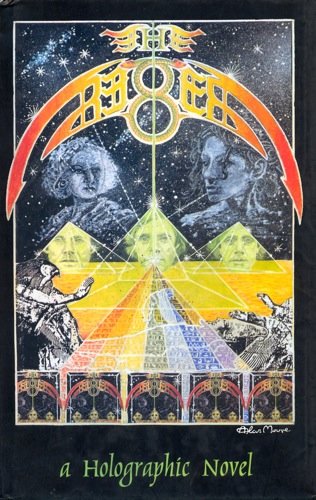
Peter Whitehead’s The Risen (1994) follows three characters – a crystallographer, an actress and a sculptor – as they retreat to an isolated house in Cornwall. There they entangle themselves in a sequence of intense, shamanic rituals: initiatory processes that help them establish contact with John, the novel’s fourth character. John is a Syd Barrett avatar, a psychonaut who has vanished leaving only a set of coded messages behind. Throughout the novel he exists as an absent presence, an entity who haunts the text just as much as he haunts the characters. Reading like a smart-drug infused cut-up of H.P. Lovecraft and Jacques Derrida, The Risen unravels following the progress of these personalities as they intersect, interfere and entangle with each other, on numerous planes at once.
In The Risen, what happens on one plane of existence influences those that stand in horizontal and vertical proximity. The past and the present; the ‘real’ world and the afterlife; the textual realm and the digital; they each collide and intermingle as the novel gradually works its way into a mind-bending field of synchronicity and simultaneity. Whitehead called this structure holographic. He likened The Risen to a half-silvered mirror through which a laser is fired and which produces, in the spaces between, a ghostly, two-dimensional image that appears also to stand in three dimensions. 

Image result for the risen whitehead
1997 paperback edition 
Risen, The: A Holographic Novel: Peter Whitehead
1994 hardback edition


28/06/2019. On the turn-in there was a familiar figure strolling through the village. Recognized the gait and stance. Time to consider my own. Head in to the place, down a path of heavy humming. Mixed feelings, most to do with the reasons for the absence. But this much said, such preparations are, and should be, for naught because – of course – it is not my day.
Whitehead wrote many novels, but during the time I knew him – first as a friend, then as a collaborator and then, for a while (2009-2014) as director of his archive – he consistently referred to The Risen as his touchstone work, a book that summed up how he wrote, why he wrote and what he wrote about. The novel had its origins in Nighttrip (1969) an unproduced screenplay about a long, mystical drive into the heart of an occult system. Other prose versions followed as Whitehead moved through the 1970s and into the 1980s via different countries and different lives: film-maker, writer, falconer. The version published in 1994 contained aspects of these prior iterations but it also drew on the heady underground atmosphere of the early-1990s, becoming in the process something of an unconscious lightning rod for the neo-counterculture of the late twentieth century. The cult independent publisher Creation Books initially had plans to issue The Risen, it was listed and is still carried by Midian Books and when published by Hathor it generated interviews and features in the likes of Esoterra magazine. Whitehead read from The Risen alongside Iain Sinclair, Chris Petit and Brian Catling at Disobey’s Subversion in the Street of Shame event in July 1994 and references to books like Robert Temple’s The Sirius Mystery (1976) – the kind of speculative Egyptology that reached a critical mass of popularity at the turn of the millennium – peppered the text. In short, it was exactly the kind of novel you could read alongside Clive Prince and Lynn Picknett’s The Stargate Conspiracy (1999). 


Another important influence was Rupert Sheldrake’s concept of morphic resonance, an idea he outlined in two Whitehead favourites, A New Science of Life (1981) and The Presence of the Past (1988). In short, morphic resonance describes a form of collective memory in which self-organising systems pass on information through patterns of repetition, cycles that appear able to extend influence across vast swathes of space and time. Sheldrake draws on plant sciences and an array of animal behaviour to explain this model of inheritance and to make a case for its significance as regards such doubted phenomena as telepathy. In The Risen, Whitehead used a similar concept to explain the psychic communication between his ‘earthly characters’ and the vanished, transformed intelligence calling itself John. He termed it ‘The R-Field’, the ‘R’ standing for ‘reincarnation’, amongst other things. For Whitehead, this described an aether-like medium in which the trans-dimensional and trans-temporal events of the novel take place. Whitehead also gave the R-Field a powerful symbol within the text, a location that the narrative obsessively returned to: a small inland clearing of trees within the Cornish landscape that he called, simply, the copse.
28/06/2019. After the Church, the plan was to drive back round the old haunts – the first house, then the car park island with its smattering of shops. It's full when I get there so there’s no photo. The house is also hard to find, even though everything seems a lot smaller than I remembered. The very first visit to the house had been a ghostly pursuit, the rest a kind of pupillage or initiation.
The copse is a thin space, a locus in which the various planes that flow through the novel converge into a point of intersection. As the novel progresses, it becomes clear that the copse is the place where John disappeared, or rather moved on. Initially, Whitehead’s use of the location recalls John Michell’s speculations on leys and ceremonial mounds as meeting places between men and gods. That said, for Whitehead, the copse does not relate solely to ideas from the Earth Mysteries scene. He offers it as an interstitial location, the novel’s holographic centre; a site at which one thing becomes another and in between a third space momentarily opens. As describes in The Risen, it is the letter ‘r’ which separates the word ‘corpse’ from ‘copse’. One word contains the other even when it is not articulated. So too with John’s progress in the novel. He’s not there, but neither is he entirely absent. His presence ripples through the text, felt and recognised but never fully manifest. There is no ‘return’ from the elsewhere but an increasing re-enactment on the part of those who remain; a growing awareness that their exploration of a set of interconnected texts is a re-plotting of John’s narrative. In the esoteric world of The Risen, this involuted unfolding of one narrative within the space of another is intended to describe nothing less than a system of reincarnation.
28/06/2019. Leaving the place, I’m circling: I’m driving round the same network of tight, overcrowded roads that used to lead from one of the houses to another. We worked at a few different locations dotted around the area and they formed a kind of circle around the town bordered by the vestigial countryside. New housing developments had ornamental lakes hewn out of the ground, pushing back the tree line. Going through the motions, other journeys come back like the time I drove there blind in thick fog. Others I spoke to reported appearances up and down the road. Signalmen at the crossroads jostling with phantom hitch-hikers. On more than one occasion, when driving with him, he would point to a gathering of trees and announce that it was the copse. He seemed to be in search of it. Seen from the moving car, these isolated alcoves blurred into strange shapes: static points in the landscape lost in flicker. Difficult to find on a return journey and even harder to capture in an image. The video would shimmer as it struggled to pick out the detail. 

*

2019/08/11

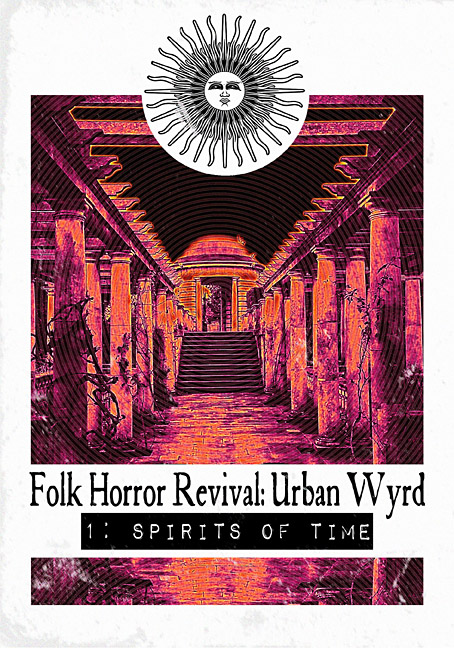
Folk Horror Revival: Otherworldly and Urban Wyrd

39294247urbanwyrd1.jpg


The good people at Folk Horror Revival and Wyrd Harvest Press continue to publish brilliant tomes based on their events and online activities. I was asked to contribute to two of their recent volumes: Otherworldy based on a live event at London's British Museum in 2016 and Urban Wyrd 1: Spirits of Time. I participated in the British Museum gathering and the volume includes a version of my talk: 'Sinister Networks'. This, in turn, was an expanded piece based on two previous posts here about canals, snakes and mythology. Urban Wyrd features 'Voices from the Ether', a text based on the talk about EVP, Iain Sinclair and ghost voices I gave at Brompton Cemetery as part of London Month of the Dead.  

My thanks to Folk Horror Revival for having me involved. 


2016/12/31

Foxhill


A recurrent trope of the ongoing Slender Man narratives is the uncanny representation of public / recreational areas: playgrounds, parklands, nature trails. There’s the Red Tower in Marble Hornets, an industrial structure located somewhere in Oak Mountain State Park, Alabama; the Rainwood day-camp in DarkHarvest00 and the boardwalk in Victor Park, Florida that serves as a key location in TribeTwelve. These are each open, ostensibly public spaces geared towards outdoor pursuits, the preservation of wildlife habitats and an attempt to connect ‘leisure’ with the experience of ‘nature’. As they appear in the videos, they’re also strangely typical, like something out of Patrick McGoohan’s The Prisoner, a generic packaging of nature as a series of non-descript features: the lake, the camp, the tower. Before it came to something of an abrupt halt, the Marble Hornets team appeared to be mapping out a similar territory in their follow-up Clear Lakes 44. Set in what appeared to be a suburban housing project, its unobtrusive landscaping, sparse interiors and pleasant but resolutely unexceptional vistas created a sterile, resonant ambience out of which the anomalies of the series emerged.

Marble Hornets: The Red Tower

As well as offering convenient ‘found’ locations for the production of these videos, the use of civic non-places clearly fits in with the ideas and aesthetic of the ‘original’ Slender Man meme. Posted by Eric Knudsen / Victor Surge on the Something Awful forum in 2009, one of his photo-shopped images attributed to ‘City of Stirling Libraries, Local Studies Collection’, depicted a group of children at a playground. Visible in the background is a tall, elongated figure with tendril-arms who holds court over a second group. It’s not clear whether they are departing the scene in the company of the Slender Man or if they are approaching the children in the foreground. To this already unsettling scene Knudsen appended short, caption-like texts that permitted it to leap from doctored image to active myth. Dated to 1986 with the added detail of ‘photographer: Mary Thomas, missing since June 13th, 1986’, Knudsen offered the following as context:
One of two recovered photographs from the Stirling City Library blaze. Notable for being taken the day which fourteen children vanished and for what is referred to as “The Slender Man”. Deformities cited as film defects by officials. Fire at library occurred one week later. Actual photograph confiscated as evidence.

It’s easy to see why this post quickly went viral. Here, ready for instant development is the signature combination of elements that constitute hauntological folklore. As with the likes of Black Meadow there’s invented history, public institutions, paranormal evidence and a fictional narrative pertaining to catastrophic loss. All this neatly packaged together by way of a framing device of re-mediated, archival investigation, in this case a ‘recovered’ photograph posted to an online forum.

That said, in addition to the form of Knudsen’s image, the importance of its depicted setting should not be underestimated in the appeal of the Slender Man motif. As the subsequent additions to the ‘mythos’ have demonstrated, there is something neo-gothic about the public park, the nature reserve and the recreation ground. Hovering somewhere between the great outdoors and the city limits, alternately crowded and deserted, full of sights and sounds that one should not find in dense urban areas, the spaces are the perfect breeding ground for the Slender Man. The character is similarly neither here nor there, he’s a figure of spooky nostalgia who’s also utterly contemporary and who, like the childhood park can be found in any town, but seems to be indigenous to points of specific visitation.

Tribe Twelve: The Boardwalk

This morning, I went for a walk round Foxhill Bank Nature Reserve in Oswaldtwistle. It’s a 22-acre site that occupies a shallow, wooded valley. Tinker Brook (a tributary of the River Hyndburn) runs through the middle and the site as a whole converges around two still-water lodges. The larger of the two holds a small island out of which grows a sprawling tree. As the Lancashire Wildlife Trust describe it,

[…] the lodges were originally constructed for storing water for the dyeing and printing of fabrics and major work was needed to convert [them] from concrete-sided reservoirs into their present-day form. Vegetation has since colonised the lodges producing a mosaic of open water, Reedmace, Soft, Hard and Jointed Rush and Common Reed. This, along with the undisturbed scrub and bramble, provides seclusion for Coots, Moorhens, Mallard and many warblers.

This conversion was completed in 1999. Prior to that the reserve was the former site of the Foxhill Bank Printworks which first opened in 1780. The ‘dyeing and printing’ relates to the production of calico fabric which was a staple Lancashire commodity until the end of the nineteenth century. At the turn of the twentieth century Foxhill bank entered voluntary liquidation but managed to survive as a bleaching plant until 1958. From here it fell into what Hyndburn Council called ‘disuse and ruin’. For more than a decade the plant works stood in some state of dereliction along with their vast bodies of still, stagnant water. Moves were made in 1987 to fill-in the whole site but the public support for a nature reserve won-out and the reconversion began.


Foxhill bank borders onto another area called White Ash. We used to go walking there and Foxhill Bank, seen from the higher fields of White Ash was an ominous, chemically-infused wasteland: the point where White Ash and its brooks simply ran-out. I have a particularly strong memory from what must have been the late 1980s / early 1990s. I’m looking down from the top path and I’m seeing a dense, black space full of earth movers and bulldozers. Half-structures and industrial ruins are strewn about and the two vast lodges gape open, full of thick, grey water. There doesn’t seem to be any discernible pathway between the piles of molten rubble. The site also goes on for miles, it seems. On more than one occasion I think I dreamt of this scene. Weird, terrifying dreams about reaching the end of everything.


The Brain

The conversion of the site was an interesting process. It happened gradually, quietly even. Pathways emerged, industry was covered over. Concessional gestures appeared on the borders. I remember during one walk through White Ash we came across a new clearing in the tree line and a fresh set of climbing bars. Long rusted goalposts were replaced. A horse paddock appeared and before long a bike track pushed its way out of the ground. As the landscape down in the pit was smoothed out, the cosmetic benefits of its transformation spread elsewhere.

This was, and is, all to the good. Foxhill has become a lovely place. Since 1999 it’s developed into a fertile ecosystem that looks as if it’s been there for generations – despite the area’s much longer, deep-rooted industrial heritage: an underlying, two hundred-year history of dyeing, bleaching and chemical processing. For me through, the site extends a pull precisely because of the proximity of this ‘other’ life. In part, I think I walked out this morning looking for, or at least hoping to find, traces of Foxhill’s shadow-self: the supermarket trollies that float in the brook; the iron bars fixed into the flowing water that shore up the flotsam; the vague chemical sheen that’s still carried by the main lodge.  

This sense of prior form is, I think, what Marble Hornets and Tribe Twelve et al are keying into via their choice of location. Particularly in the case of Adam Rosner’s Tribe Twelve, the Victor Park boardwalk becomes the site of the Slender Man’s first appearance in the series: complete with the character’s accompanying video distortion. Just before this visitation, Milo Asher – the subject of the haunting – expresses his utter disinterest in the lake at the end of the boardwalk: there’s nothing there. In amongst its themes of visitation and disappearance, the first few episodes of Tribe Twelve capture the intense boredom of its suburban environment. Neat houses surround ornamental lakes, finely cut grass borders neat roads and the brand-new, flat-pack boardwalk leads to a neat, almost off-the-shelf, body of water. It’s the type of polythene space which is utterly at odds with the dense, ancient and peripheral woodlands where we might expect to find the supernatural. And yet, the Slender Man appears.

This combination of sanitized space and anomalous event brings to mind the final scenes of Edward Hunt’s The Brain (1988) in which a superimposed triangle containing a hideous face appears to rupture a sedate suburban horizon. It’s not an image of that which is long-buried within the location but something which is intradiegetic, existing momentarily in the space between the viewer and the depicted location. Hunt’s ‘Brain’, like the Slender Man is a figure that’s designed to suit these depthless spaces, those which have truncated or otherwise shallow histories. Were Foxhill Bank ever to generate its own monsters (stalking things in white calico hoods - the uniforms of solitary convicts?) they would be similarly interstitial. Despite its deep roots, the site has neither erased nor buried its industrial mould. Wait until the ice has left the surface of the lodge and take a sounding. Physically, the water is very deep. But it sits within a basin that’s been re-sculpted out of the existing industrial curvature. There’s no subterranean history beneath it. Just two spaces intersecting in simultaneity, possibly generating a third.


2016/06/08

The Alchemical Landscape II

Headlands

Following on from the success of the first Alchemical Landscape symposium in March 2015, we're mounting a second event. It will be held at Girton College, Cambridge on 7th July. For more details relating to ticket purchase, venue and to see a draft programme, please head over to the project website.

Images from The Other Side


Haunted Tape
Photo: Evie Salmon

Thanks to everyone who worked hard to make The Other Side such a successful event: Evie Salmon, Jo Brook, Jeremy Hardingham, Robin the Fog and Howlround, Andy Sharp, Hannah Gilbert and Documents. It was great to see so many people there. I think we really achieved what Bad Timing and The Alchemical Landscape set out to do! We've gathered together various photographs, video and sound files as documentation of the event. Scroll down for some images and captions. A link to video evidence will follow shortly. Bad Timing have a photo collection visible here


Preparing for 'Dust'
Photo: Evie Salmon
'Dust' in performance
Photo: Jo Brook
'Dust': Strange energies 
Photo: Jo Brook 
Documents preparing 
Photo: Evie Salmon 

Documents in performance 
Photo: Jo Brook
Documents: Boleskine House
Photo: Jo Brook
Bad Timing DJs
Photo: Ed Ramage 
Matter and sound
Photo: Ed Ramage
Machine noise 
Photo: Ed Ramage 
Bad Timing DJs: at the controls
Photo: Ed Ramage
Howlround: View from the bridge
Photo: Evie Salmon 
Howlround in action 
Photo: Evie Salmon 
Howlround, audience and extended tape
Photo: Jo Brook
Howlround after show
Photo: Jo Brook


2016/04/24

The Other Side

Bishop James Pike

I'm very happy to announce 'The Other Side: An Audiophonic Séance'. Working with Evie Salmon under the Alchemical Landscape banner, we've had the pleasure of collaborating with Jo Brook of Bad Timing to bring together "a night of dead formats, traces, sites and spectres from the underground". 

The event features a series of acts and performances connected via a shared interest in the mediumistic power of recording technology: 

Howlround
Documents 
Evie Salmon & James Riley performing 'Dust'
bad timing djs: mix tapes from the underground


We'll be holding the event at the Judith E. Wilson Drama Studio, Faculty of English, 9 West Road, Cambridge on Thursday 12th May, 7.30pm. 

Tickets are free but places are limited. Please reserve via eventbrite:

https://www.eventbrite.co.uk/e/the-other-side-an-audiophonic-seance-tickets-24826139652

We're also inviting you to consider a £5 donation towards performers' travel costs. 

For more information, see the Bad Timing website and scroll down for details of each act. 


*

Howlround is an ongoing exploration of the possibilities of magnetic tape as a creative medium for electronic music. Their live performances and compositions are created entirely by manipulating tape loops of natural acoustic sounds on vintage reel-to-reel machines, with additional reverb or electronic effects strictly forbidden. Their fourth LP Tales From the Black Tangle was released at the end of 2015 and was a dark and compelling concoction of industrial sirens, foghorns, seawash, ship to shore distress signals and even the creaking of a Broadcasting House microphone cradle in need of some oil.

'Uncanny, mesmerising, difficult and sublime' The Quietus

http://www.howlround.co.uk/

Documents is a nascent development of the long running creative occult project English Heretic. Documents has been set up to explore a remit of ethnographic recordings from the imaginal world. Combining the aesthetic of Bataille's surrealist journal Documents with the hermetic psychology of James Hillman, the project represents a deepening of the themes laid out by English Heretic. Documents first broadcast was released on the Eighth Climate imprint in December 2015.

Documents will perform two pieces. "Music For The Execution Of Geoffrey Firmin" An imaginary séance for the tragic protagonist of Malcolm Lowry's Under The Volcano abstracting dialogue from the film adaptation of Lowry's book to achieve rapport the spectre of Firmin. "Last Broadcast at Boleskine" manipulates field recordings taken at the cemetery overlooked by Aleister Crowley's notorious Loch Ness home. These recordings, carried out on the 1st December 2015, anniversary of Crowley's death, shortly before Boleskine House burned down, constitute music to precipitate the violent demise of an abode on the borderland. Together these pieces explore landscape, film and documentary dialogue as a form of theatrical EVP.
http://www.english-heretic.org.uk/EighthClimate/

Evie Salmon and James Riley work across multiple faculties at the University of Cambridge. They co-direct The Alchemcial Landscape, an ongoing research and public engagement project looking at occulture and geography.

'Dust' is a speculative investigation into the afterlife of two lost recordings by Jack Kerouac and William Burroughs. Spoken word, archival murmurings and dead formats.

http://residual-noise.blogspot.co.uk/
http://thealchemicallandscape.blogspot.co.uk/

bad timing djs mix tapes: experiments from the underground


*

A note on the image above: Bishop James Pike (1913-1969) was an American Episcopal Minister, one of the first to make regular television appearances. Following the death of his son in 1966, Pike began to experience paranormal phenomena. In 1967 he appeared with the medium Arthur Ford as part of a television seance to contact his son. These experiences formed the basis of his book The Other Side (1969). Philip K. Dick based the character of Timothy Archer on Pike when he wrote his novel The Transmigration of Timothy Archer (1982). 

Pike and his book will not be directly referenced on May 12th, but for obvious reasons his symbolic life has informed some of the thinking behind the event. 

2016/01/06

Ghosts Everywhere

I was back up North recently to do a talk on Gothic writing. During the trip I found myself drawn, drawn, to an area I used to visit as a child: the Accrington – Blackburn stretch of the Leeds and Liverpool Canal. I’ve written about this waterway before. But this particular section, known semi-officially as Cycle Route 6, is the part I had in mind when going on about strange snake appearances.

Cycle Route 6:
complete with raindrops on the video camera lens
This spot marks out something of a borderland between open fields and dense industrial sites. Upstream, the canal moves past a series of small towns and remains largely hidden at their edges. Sometimes it will raise its head at a road bridge but it mainly seems content to meander beside fields and (now more likely) golf courses. But at this point, just before Church Kirk, the canal leaves a wide open expanse and begins to narrow as it moves alongside the flanking walls of Blythe Chemicals. I could make a cheap point and allude to Axis Chemicals from the 1989 Batman film which, to be honest, I always had in mind whenever I passed the factory site. But to draw on such a deliberately blighted image would entirely miss the point. There’s no binary tension here between the industrial and the rural, with the former as some kind of pox upon the latter. It’s easy to place canals with roads and railways as transportation systems that have encroached upon and negatively impacted the landscape. But like hedgerows, dry stone walls and towpaths, the canal represents another form of infrastructural cultivation that has scaped the land over successive generations of its working life, both agricultural and heavy-industrial.

You can see the traces of this intermingling all along the pathway. Before the canal meets the yards at Blythe's, you come across a set of submerged coke ovens: odd, brick igloos once used to carbonize coal. Most of them have been filled in and you can just about see the brick domes undulating under the scrub-land. In the late 1980s and early 90s though, they were much more exposed and lay like pit traps in the ground. I think someone once made the obvious link and used them as the backdrop for a film about the First World War. Part trenches and part mortar craters, they carry the archaeological resonances of the site, much like the imprinted caisson walls in J.G. Ballard’s Empire of the Sun (1987).

Today it’s clear that the canal has moved away from its role in factory trade and transportation, but this specific stretch of waterway is not entirely post-industrial nor is it fully gentrified. Despite the occasional houseboat and despite being implicitly re-branded as a leisure site, Cycle Route 6 doesn’t seem to have fully shaken off the dust of its coal-charging past. It's redundant in the original sense of the word: the waters are still, but it feels active with industrial and chemical energy. Rammed somewhere between a chemical plant and the Nori brick works up at Whinney Hill; crossed with railway lines and in sight of garages and back-street scrap yards, it’s not particularly picturesque, it’s not particularly quiet and it’s always looked stagnant, like something straight out of John Barr’s Derelict Britain (1969). This, of course, is why I like it so much.

The House on the Borderland
I had been reading Susan Hill’s The Woman in Black (1983) ahead of the trip. In addition to understanding the value of a carefully constructed framing device, Hill places her writing well within the tradition of M.R. James and horizontal, landscape gothic. Where James has his East Anglian beaches, Hill transplants wintered Suffolk to the imaginary marshlands of the north east, “a remote corner of England”. Crossing the Nine Lives Causeway to reach the notorious Eel Marsh House, Hills’s narrator Arthur Kipps describes the estuary plain as a space of sublime bleakness:

Today there were no clouds at all, but I could well imagine how magnificently the huge, brooding area of sky would look with grey, scudding rain and storm clouds lowering over the estuary, how it would be here in the floods of February time when the marshes turned to iron-grey and the sky seeped down into them, and in the high winds of March, when the light rippled, shadow chasing shadow across the ploughed fields.

The monochromatic colour-scheme, the rain, the flatness and the sly hints of agriculture and industry: all this matches my impressions of the Accrington-Blackburn canal. It matches my impressions but also, inevitably, my memories, complete with all the fabricated, simulated and nostalgic productivity that accompanies them.

Shortly after this description comes Kipps’s first encounter with Eel Marsh House itself:

It stood like some lighthouse or beacon or martello tower, facing the whole, wide expanse of marsh and estuary, the most astonishingly situated house I had ever seen or could ever have conceivably imagined, isolated, uncompromising but also, I thought, handsome. As we neared it, I saw the land on which it stood was raised up a little, surrounding it on every side for perhaps three or four hundred yards, of plain, salt-bleached grass, and then gravel. This little island extended in a southerly direction across an area of scrub and field towards what looked like the fragmentary ruins of some old church or chapel.

This is James’s preceptory rendered by way of Poe’s House of Usher. The marshland is another “singularly dreary tract of country” where Kipps ‘finds’ himself after travelling “the whole of a dull, dark, and soundless day”. On Route 6 there’s a similar house that stands in the fields on the far side of the canal. It lies parallel with the verge of the railway elevation on a small valley floor. In my mind this tract was an open, barren plateau in which the single house stood as if on a parched island. As a child I remember passing by and feeling something like vertigo. You walk down a path that’s filled with vegetation, but as soon as the tree line breaks, the space opens out to this seemingly vast expanse and there’s this lone anchor embedded in the middle of it. Hill’s ground of “plain salt-bleached grass” brought all this back to me. As with the space she describes in her book, what I remember is an area utterly different from the surrounding fields. Punctuated by the brick domes of the coke ovens and no doubt blasted by years of their exhaust fumes, it felt flat, bleached and drained. There was also this long, serpentine chemical pipe running across the far side like some kind of zonal marker.

Heavy rain
When I went back there the whole place was smaller. It was compact, neat and even. Just a house beyond a fence. I doubt this difference came about due to the shaping and re-shaping of the landscape. In fact, I doubt that my earlier version ever physically existed. So where did it this ‘remembered’ area actually come from in the first place? It feels like an old memory rather than a recently mis-remembered veneer. The combined scene of factories, water and strange dereliction is one that I’ve often imaginatively returned to. And it’s been the connection – emotional, probably – to this set of images that has led me to certain texts, not the other way round. That’s to say, I don’t think reading James et al has embellished this place-memory. I’ve gravitated towards his texts and similar, in part, in order to further extend a type of psychic purchase in the memory of an area that was already heavily embellished.

I like these hinterlands precisely because they carry this generative effect: they prompt ideas and images. My home town and its environs is full of yards, quarries, canal paths and millponds. The train out of Accrington used to pass over all kinds of factory sites with their standing waters, holding areas and stockpiles. It was not unlike flying over an apocalyptic scene. Every time, the response was a series of questions: what is this place? Who works here? What happened here? The resonance they emit has little to do with a ‘past’ or any other original point. Instead, it’s more like a continuing oscillation. Now that the industrial and geographic landscape of Route 6 has changed, I don’t mourn the ‘loss’ of the canal side I knew as a child. I never knew it in this form. The weird vista I’ve had in my head for a couple of decades has always been in there. And I’m happy for it to stay in its dome and to continue to develop in whichever way it wants.

Hill knew all about this internal landscape. Here’s how she described Suffolk in “the Seventies”:

The blackened hull of a rotting boat lay low in the mud. The last geese squawked home in the darkening sky. I sensed ghosts everywhere, looked behind me as I walked faster. There was a strange, steely light glinting, and shadows. Easy to let your imagination run away with you there and the scene stayed with me, though it was another 10 years before I actually made use of it.

She made use of it when composing The Woman in Black. Imaginary Suffolk was transplanted to some indeterminate “corner” as part of Kipps’s journey “North”. Whatever haunted her about her daily walking route had little to do with the land itself. What stayed with her was the germ of the work to come.