Showing posts with label the north. Show all posts

2026/04/09

Go Back to the House


At work in the corridors

Splatterhouse is a horror-themed video game released by the Japanese developer Namco in 1988 and later ported to the home console Turbografx-16 in 1990. Heavily influenced by films like Friday 13th (1980), The Evil Dead (1981) and Re-Animator (1985), the plot follows students Rick and Jennifer as they seek shelter from a storm in the mansion of Dr. West, a missing parapsychologist. Because of rumours connecting the mansion and its inhabitants to weird, terrifying experiments, Dr. West’s gothic pile is known locally as the ‘Splatterhouse’. Despite this reputation (and in the tradition of the finest horror film decision-making), Rick and Jennifer prefer to be in the Splatterhouse than out in the rain.  Upon entry, the door slams shut behind them and the pair are plunged into darkness. Jennifer screams, Rick passes out. When Rick wakes up Jennifer is gone and he is different. Rick has been possessed by one of the entities in the house, a sentient ‘Terror Mask’. Fusing itself to his face, the Terror Mask transforms Rick into a monstrous Jason Voorhees-type figure. Enraged and guided by the mask, Rick sets off into the endless corridors of the Splatterhouse to rescue Jennifer. Along the way pummels into oblivion all the demonic creatures he encounters. This – rather than the rescue – is the main task of the game: it is, after all, a side-scrolling beat ‘em-up. In the event Rick doesn’t rescue Jennifer, but instead destroys hundreds of creatures and burns the mansion to the ground.

Rick’s fascination / entanglement with the mask is an apt symbol for the appeal of the game. Lurid and often grotesque, you shouldn’t like it, but you do. As with most beat ‘em-ups there’s queasy satisfaction to be gained from the endless carnage you can mete out to enemy after enemy. Thanks to this graphic content the game was one of the first to receive a parental warning. Like Doom (1993) and later Carmageddon (1997), Splatterhouse holds a particular place in video game history. It marks the point at which games started to get harder, not just in terms of difficulty but also in terms of what they were prepared to show. Splatterhouse and these others, as well as drawing on cult cinema of the early-to-mid 1980s, also paralleled the return of various ‘video nasties’ to the high street across the later-1980s and 1990s. Companies like VIPCO had done a VHS re-release of Lucio Fulci’s The House by the Cemetery (1981) in 1988, and if you watched that along with their 1992 version of Michael Pataki’s Massacre Mansion (1975), you’d have more than enough content to put together a hypnagogic version of Splatterhouse: The Movie.  There are better side-scrollers than Splatterhouse, of course, but few in my view that better manage to crystallize up the very particular collision that occurred in 1990s popular culture between horror movies and video games.

When Splatterhouse 2 arrived on the Sega Mega Drive in 1992, the graphics had improved and the story had extended. The sequel was set three months on from the first and found Rick plagued with nightmares about his failure to rescue Jennifer. Meanwhile, having broken into pieces at the end of Splatterhouse, Splatterhouse 2 finds the mask having re-assembled itself and it begins to talk to Rick. "She doesn't have to die, Rick […] We can save her […] You need me", it says before adding a further clarion call: "Go back to the house." What the game calls the mask’s “infernal temptations” eventually prove to be too much. Rick puts it on again, picks up his nail-studded plank and heads off towards the charred remains of the West mansion where he does, finally, find Jennifer. 

Recently I came across a (very overpriced) copy of Splatterhouse 2. I was infernally tempted to buy it. Like Rick with the Terror Mask, I felt myself drawn to it. It would, however, have been a distinctly talismanic purchase. I would not have been buying it for the dubious pleasures of the game alone. I wanted the cartridge because it would have conjured something else. It would have brought back my memories of the first Splatterhouse; not a memory of the event of the game, - the ‘how’ and ‘why’ of it, the actual playing of it, but more like the ‘when’ and the ‘where’ of it: the place in which and the time at which I first came across it. To be more specific, buying the cartridge, I thought, would have brought into sharper focus a memory of encountering the original game in the mid-1990s, by way of an old arcade machine in the foyer of the Unit Four Cinema in Brierfield.

*

Brierfield is a town just outside Burnley in Lancashire. According to H.J. Hill, writing for the website cinematreasures.org, Brierfield Cinema was the first “purpose-built cinema” in Burnley. It opened on 15 July 1915 with a capacity of around 600 seats and continued trading as a cinema until 1959. From there the building went through a series of changes: 


In April 1959 it opened as a sports hall; that failed. It then opened as the Rockin’ Shoe Disco on Sunday 21st July 1961; that too didn’t last. It opened on 15th December 1961 as the 77 Club: cabaret and gambling. That went well until changes in the gambling laws affected business and it closed in November 1967.


From here the building re-opened as Unit Four Cinemas in July 1969 before the Apollo Group in took over ownership in 1989. My family and I started going to Brierfield just before the handover, first to see Crocodile Dundee II (1988) and then The Adventures of Baron Munchausen (1988). The latter gave rise to my earliest attempt at film reviewing – trying to tell my horrified primary school teacher about this film I’d seen at the weekend that involved torture, decapitation and the screeching, skull-faced figure of Death. Later on, my father and I went there to see Judge Dredd (1995) and Mortal Kombat (1995). I was not quite fifteen. No matter. One of the many great things about Brierfield was that they would let you in for anything. This was mainly because during the late 1980s and into the 1990s, footfall was low (or so it seemed) which had the effect of making any visit akin to a private screening. Such unintended privilege, unsurprisingly, was also the cinema’s downfall. In 1997 Apollo opened a larger multiplex closer to Burnley’s town centre. Brierfield was given little time to compete. The new cinema opened in May 1997  and by July of that year, Brierfield had closed its doors for good. As Hill reminds us, its last screening rota was the remarkable quartet of Batman and Robin, The Fifth Element, Con Air, and Beavis and Butthead in America. What a way to go. New businesses took over the site soon after, and used it as a single storey site. Most recently, the building was trading as a Dixy Chicken take-away and Maria’s World Food Store.

Going to the cinema in the 1980s and 1990s involved a lot of enticing glimpses. When you were waiting in the foyer or walking through the corridor and the doors of a screen opened, you craned your neck trying to get a look at one of the films you weren’t there to see. One of my earliest cinema visits was to Accrington’s Unit Four (closed in 1990). This was about 1987 – the time of the first Robocop – and the sheer pull of it - the thought, when sat watching that year’s Disney film, that such sci-fi carnage was playing out just next door - was almost irresistible.

Brierfield probably would have let you in for Robocop. All comers would have been welcome. But despite its ‘unfiltered’ approach to admission, it was also not short of the hypnotizing glimpses – its own internal otherworlds, you might say. Aside from the posters on the walls – some of which stayed up for a long time (The Adventures of Milo and Otis (1989), anyone? Cutthroat Island (1995)?), there was also an array of arcade machines in the upper foyer, three at least. All unlabelled. Black boxes that stood there like the hidden-in-plain-sight recruitment machine in The Last Starfighter (1984). These three included Splatterhouse. Playing it after seeing a film was like a grisly extension of whatever fantasy had been shown on screen. The game was not so much as task – can you beat the enemies? – as a mapping machine: how far can you go? Charging through the mansion felt like a way of extending the films – real or imaginary – while they were still in the air. Post-credits, out into the light, the game, already saturated with weird film energy offered a way to stretch the cinema into longer, labyrinthine corridors.

*

In his novel The Director’s Cut (2000), Nicholas Royle has one of his characters – the production assistant Angelo – compulsively wander London in search of lost or abandoned cinemas. It’s a visionary project in which maps, film listings and architectural traces combine into Angelo’s all-consuming psychogeographic fugue. Filmmaker Chris Petit – namechecked in the novel – wrote in his classic essay ‘Newman Passage’ (1993) that finding film locations across London like Maryon Park (used in Blow-Up (1966)) and the sinister title alleyway that appears in Peeping Tom (1960), was a way of orienting himself after he had first arrived there to work for Time Out. For Petit, these visits became a way of gaining purchase; of carving out personal territory in the otherwise anonymous capital. Angelo’s project covers many of the same zones, but travels in the opposite direction towards sites of projection rather than initial recording, his guiding thesis being: “where a film is shown is more important than where it’s shot”. Angelo archives the lost cinemas via a collection of empty VHS cases, each one acting as a spatio-temporal reliquary. His ‘copy’ of Petit’s Chinese Boxes (1984) carries the note “Roxie, 9.12.86”, a cinema that closed in March 1987. The box is a pocket of the lost cinema’s air, something of the emotion the space would have absorbed, night after night, as successive films were projected there. Angelo’s Chinese Boxes, then, “is more a faithful record of [his] experience of Chinese Boxes than a copy of Chinese Boxes itself.”

The same, I believe, is true of the Splatterhouse 2 cartridge. As a container (‘cartridge’ come from cartouche, a “full charge for a pistol”) it contains more than a circuit board. It is very much not the game played in Brierfield, not even a copy of it. It is, though, a box that sparks the necessary charge of memory; a box that contains the required psychic gunpower to blow the necessary hole in reality big enough to see the vanished corridors beyond. A way of getting back there and, crucially, then. Angelo in The Director’s Cut was in search of “the Museum of Lost Cinema Spaces”: a grand cathedral of the ideal, a sanctuary away from the storm of heavy black clouds. My lost cinema space is more singular, more specific – a very particular venue that has, nonetheless, continued to carve out a territory in the mind since it closed. Seeing the cartridge filled in the remaining space in the synaptic gap. It brought it back and held out the possibility of a return, or sorts. Sometimes, when there’s a persistently resonant chamber rooted in the brain, you need the right kind of key to open it up.

Ok then: sold. I’ll buy it. I won’t play it. I’ll use it instead. I’ll use it to go back to the house. 


2019/08/11

Folk Horror Revival: Otherworldly and Urban Wyrd

39294247urbanwyrd1.jpg


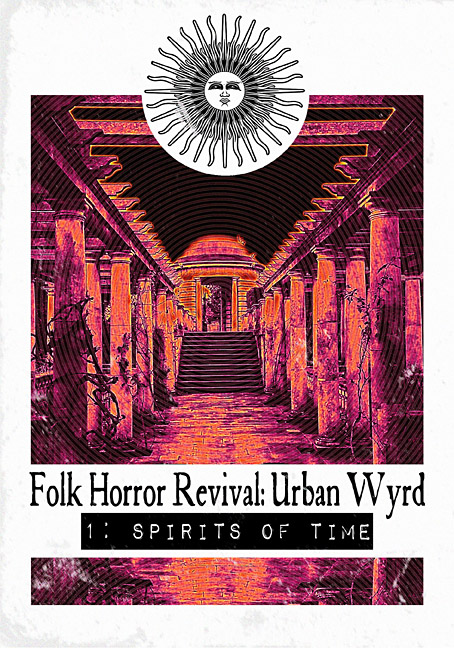
The good people at Folk Horror Revival and Wyrd Harvest Press continue to publish brilliant tomes based on their events and online activities. I was asked to contribute to two of their recent volumes: Otherworldy based on a live event at London's British Museum in 2016 and Urban Wyrd 1: Spirits of Time. I participated in the British Museum gathering and the volume includes a version of my talk: 'Sinister Networks'. This, in turn, was an expanded piece based on two previous posts here about canals, snakes and mythology. Urban Wyrd features 'Voices from the Ether', a text based on the talk about EVP, Iain Sinclair and ghost voices I gave at Brompton Cemetery as part of London Month of the Dead.  

My thanks to Folk Horror Revival for having me involved. 


Fortean Times / Cry of the Banshee!


Fortean Times recently published my piece on Banshees, twilight encounters and noises from the dark. The magazine included it in their Forum section. Very interesting text to write: based on a report of a wailing woman roaming the suburbs of Kirkby, Merseyside. The story first surfaced in July 2017 before additional reports came to light in September 2017 from nearby Tranmere, Rock Ferry and Beechwood. The stories suggest that the cries for help heard through letterboxes in the middle of the night were part of a strange burglary plot. Seemed to overlap with much older accounts of Banshees whose cries signalled some impending doom. 

2018/10/11

Spaces of Conspiracy

Particular spaces generate particular events. Spaces gain significance from the happenings they harbor, but there are also a set of invisible vectors that act as strange attractors. In the in-between of memory, history and architecture there is an excess that can sometimes, like ectoplasm, be caught when the light is right. 

1. Stairway: stone, rust, litter.  

'Original' event remembered from below, looking up. 

Vanishing chase to the bottom; a public argument; subsequent discussions indicate that the altercation was not all it seemed. Route now blocked. Reverb footsteps continue. 

2. Car park: concrete, white lines, engine heat. 

In the car, not pictured, as it and if it happened.


Argument across the flat space and stains on the car windows. Police trying to calm it down. Parking bays as crime outlines. Always accumulated bits. Broken. A hundred other incidents to be reconstructed. Workplace off in the distance. Gateway to a parade of offices, interlocking. 

3. River: Slate water, iron bridge, hole.

Follow this river to find a way out of the 21st century. 


Flecks of blue plastic in amongst the dirtied green. A sense of anticipation because it moves all the time. It looks more like a fuel supply than a water source. Channels like this all over the town. Most invisible though. That it should raise its head at this precise point adds another co-ordinate to the speculative map. 

2016/12/31

Foxhill


A recurrent trope of the ongoing Slender Man narratives is the uncanny representation of public / recreational areas: playgrounds, parklands, nature trails. There’s the Red Tower in Marble Hornets, an industrial structure located somewhere in Oak Mountain State Park, Alabama; the Rainwood day-camp in DarkHarvest00 and the boardwalk in Victor Park, Florida that serves as a key location in TribeTwelve. These are each open, ostensibly public spaces geared towards outdoor pursuits, the preservation of wildlife habitats and an attempt to connect ‘leisure’ with the experience of ‘nature’. As they appear in the videos, they’re also strangely typical, like something out of Patrick McGoohan’s The Prisoner, a generic packaging of nature as a series of non-descript features: the lake, the camp, the tower. Before it came to something of an abrupt halt, the Marble Hornets team appeared to be mapping out a similar territory in their follow-up Clear Lakes 44. Set in what appeared to be a suburban housing project, its unobtrusive landscaping, sparse interiors and pleasant but resolutely unexceptional vistas created a sterile, resonant ambience out of which the anomalies of the series emerged.

Marble Hornets: The Red Tower

As well as offering convenient ‘found’ locations for the production of these videos, the use of civic non-places clearly fits in with the ideas and aesthetic of the ‘original’ Slender Man meme. Posted by Eric Knudsen / Victor Surge on the Something Awful forum in 2009, one of his photo-shopped images attributed to ‘City of Stirling Libraries, Local Studies Collection’, depicted a group of children at a playground. Visible in the background is a tall, elongated figure with tendril-arms who holds court over a second group. It’s not clear whether they are departing the scene in the company of the Slender Man or if they are approaching the children in the foreground. To this already unsettling scene Knudsen appended short, caption-like texts that permitted it to leap from doctored image to active myth. Dated to 1986 with the added detail of ‘photographer: Mary Thomas, missing since June 13th, 1986’, Knudsen offered the following as context:
One of two recovered photographs from the Stirling City Library blaze. Notable for being taken the day which fourteen children vanished and for what is referred to as “The Slender Man”. Deformities cited as film defects by officials. Fire at library occurred one week later. Actual photograph confiscated as evidence.

It’s easy to see why this post quickly went viral. Here, ready for instant development is the signature combination of elements that constitute hauntological folklore. As with the likes of Black Meadow there’s invented history, public institutions, paranormal evidence and a fictional narrative pertaining to catastrophic loss. All this neatly packaged together by way of a framing device of re-mediated, archival investigation, in this case a ‘recovered’ photograph posted to an online forum.

That said, in addition to the form of Knudsen’s image, the importance of its depicted setting should not be underestimated in the appeal of the Slender Man motif. As the subsequent additions to the ‘mythos’ have demonstrated, there is something neo-gothic about the public park, the nature reserve and the recreation ground. Hovering somewhere between the great outdoors and the city limits, alternately crowded and deserted, full of sights and sounds that one should not find in dense urban areas, the spaces are the perfect breeding ground for the Slender Man. The character is similarly neither here nor there, he’s a figure of spooky nostalgia who’s also utterly contemporary and who, like the childhood park can be found in any town, but seems to be indigenous to points of specific visitation.

Tribe Twelve: The Boardwalk

This morning, I went for a walk round Foxhill Bank Nature Reserve in Oswaldtwistle. It’s a 22-acre site that occupies a shallow, wooded valley. Tinker Brook (a tributary of the River Hyndburn) runs through the middle and the site as a whole converges around two still-water lodges. The larger of the two holds a small island out of which grows a sprawling tree. As the Lancashire Wildlife Trust describe it,

[…] the lodges were originally constructed for storing water for the dyeing and printing of fabrics and major work was needed to convert [them] from concrete-sided reservoirs into their present-day form. Vegetation has since colonised the lodges producing a mosaic of open water, Reedmace, Soft, Hard and Jointed Rush and Common Reed. This, along with the undisturbed scrub and bramble, provides seclusion for Coots, Moorhens, Mallard and many warblers.

This conversion was completed in 1999. Prior to that the reserve was the former site of the Foxhill Bank Printworks which first opened in 1780. The ‘dyeing and printing’ relates to the production of calico fabric which was a staple Lancashire commodity until the end of the nineteenth century. At the turn of the twentieth century Foxhill bank entered voluntary liquidation but managed to survive as a bleaching plant until 1958. From here it fell into what Hyndburn Council called ‘disuse and ruin’. For more than a decade the plant works stood in some state of dereliction along with their vast bodies of still, stagnant water. Moves were made in 1987 to fill-in the whole site but the public support for a nature reserve won-out and the reconversion began.


Foxhill bank borders onto another area called White Ash. We used to go walking there and Foxhill Bank, seen from the higher fields of White Ash was an ominous, chemically-infused wasteland: the point where White Ash and its brooks simply ran-out. I have a particularly strong memory from what must have been the late 1980s / early 1990s. I’m looking down from the top path and I’m seeing a dense, black space full of earth movers and bulldozers. Half-structures and industrial ruins are strewn about and the two vast lodges gape open, full of thick, grey water. There doesn’t seem to be any discernible pathway between the piles of molten rubble. The site also goes on for miles, it seems. On more than one occasion I think I dreamt of this scene. Weird, terrifying dreams about reaching the end of everything.


The Brain

The conversion of the site was an interesting process. It happened gradually, quietly even. Pathways emerged, industry was covered over. Concessional gestures appeared on the borders. I remember during one walk through White Ash we came across a new clearing in the tree line and a fresh set of climbing bars. Long rusted goalposts were replaced. A horse paddock appeared and before long a bike track pushed its way out of the ground. As the landscape down in the pit was smoothed out, the cosmetic benefits of its transformation spread elsewhere.

This was, and is, all to the good. Foxhill has become a lovely place. Since 1999 it’s developed into a fertile ecosystem that looks as if it’s been there for generations – despite the area’s much longer, deep-rooted industrial heritage: an underlying, two hundred-year history of dyeing, bleaching and chemical processing. For me through, the site extends a pull precisely because of the proximity of this ‘other’ life. In part, I think I walked out this morning looking for, or at least hoping to find, traces of Foxhill’s shadow-self: the supermarket trollies that float in the brook; the iron bars fixed into the flowing water that shore up the flotsam; the vague chemical sheen that’s still carried by the main lodge.  

This sense of prior form is, I think, what Marble Hornets and Tribe Twelve et al are keying into via their choice of location. Particularly in the case of Adam Rosner’s Tribe Twelve, the Victor Park boardwalk becomes the site of the Slender Man’s first appearance in the series: complete with the character’s accompanying video distortion. Just before this visitation, Milo Asher – the subject of the haunting – expresses his utter disinterest in the lake at the end of the boardwalk: there’s nothing there. In amongst its themes of visitation and disappearance, the first few episodes of Tribe Twelve capture the intense boredom of its suburban environment. Neat houses surround ornamental lakes, finely cut grass borders neat roads and the brand-new, flat-pack boardwalk leads to a neat, almost off-the-shelf, body of water. It’s the type of polythene space which is utterly at odds with the dense, ancient and peripheral woodlands where we might expect to find the supernatural. And yet, the Slender Man appears.

This combination of sanitized space and anomalous event brings to mind the final scenes of Edward Hunt’s The Brain (1988) in which a superimposed triangle containing a hideous face appears to rupture a sedate suburban horizon. It’s not an image of that which is long-buried within the location but something which is intradiegetic, existing momentarily in the space between the viewer and the depicted location. Hunt’s ‘Brain’, like the Slender Man is a figure that’s designed to suit these depthless spaces, those which have truncated or otherwise shallow histories. Were Foxhill Bank ever to generate its own monsters (stalking things in white calico hoods - the uniforms of solitary convicts?) they would be similarly interstitial. Despite its deep roots, the site has neither erased nor buried its industrial mould. Wait until the ice has left the surface of the lodge and take a sounding. Physically, the water is very deep. But it sits within a basin that’s been re-sculpted out of the existing industrial curvature. There’s no subterranean history beneath it. Just two spaces intersecting in simultaneity, possibly generating a third.


2016/02/06

Interview with Evie Salmon in Otherzine


Otherzine, the underground film magazine based out of San Francisco's great Other Cinema, have just published their 30th edition. It’s been issued to coincide with Other Cinema's 2016 Spring Programme. Edited by Molly Hankwitz, Otherzine 30: M a T e R i A L Cinema

[…] explores the material processes of film making, whether digital or analogue, small-screen, handmade or multiplex; performed, or projected, performed and projected, historical or recent. We are especially proud of this wonderful and enigmatic collection; clever, individual pieces each a producing a thoughtful glance at or analyzing some component of “materiality” with a very  strong emphasis, as it turns out, upon “live” cinema performance, and the performance of cinema.

fleapitposters
Fleapit: Somewhere in the North
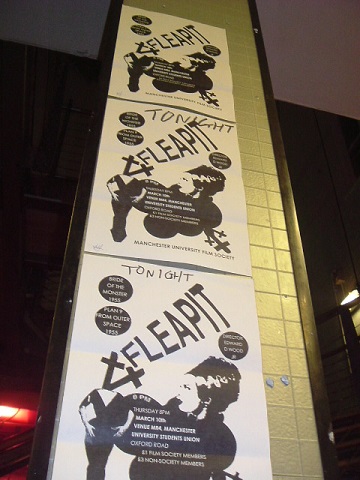
I’m happy to say that I’ve been included in this issue. The brilliant Evie Salmon graciously took some time out to interview me about Fleapit and the Road Movies project. As you’ll see from the text, because she’s been there since the start, Evie is ideally placed to ask the right kind of questions from the right kind of angle. It was a real pleasure to revisit the very earliest Fleapit shows in this interview which Evie expertly edited from a much longer conversation. Her introduction gets it bang on: shambolic shows, dodgy cowboy boots, disinterested crowds. The battlefield she describes was a brief foray I undertook to Edinburgh just as Fleapit was starting out in Lancaster. An additional point of circularity comes with the link to Other Cinema. Craig Baldwin’s work was a massive influence on Fleapit and continues to inform my thinking on film more generally. As such, it’s a great pleasure to now have the project covered in Otherzine


You can read the issue here. To go to the interview direct, click here

2016/01/06

Ghosts Everywhere

I was back up North recently to do a talk on Gothic writing. During the trip I found myself drawn, drawn, to an area I used to visit as a child: the Accrington – Blackburn stretch of the Leeds and Liverpool Canal. I’ve written about this waterway before. But this particular section, known semi-officially as Cycle Route 6, is the part I had in mind when going on about strange snake appearances.

Cycle Route 6:
complete with raindrops on the video camera lens
This spot marks out something of a borderland between open fields and dense industrial sites. Upstream, the canal moves past a series of small towns and remains largely hidden at their edges. Sometimes it will raise its head at a road bridge but it mainly seems content to meander beside fields and (now more likely) golf courses. But at this point, just before Church Kirk, the canal leaves a wide open expanse and begins to narrow as it moves alongside the flanking walls of Blythe Chemicals. I could make a cheap point and allude to Axis Chemicals from the 1989 Batman film which, to be honest, I always had in mind whenever I passed the factory site. But to draw on such a deliberately blighted image would entirely miss the point. There’s no binary tension here between the industrial and the rural, with the former as some kind of pox upon the latter. It’s easy to place canals with roads and railways as transportation systems that have encroached upon and negatively impacted the landscape. But like hedgerows, dry stone walls and towpaths, the canal represents another form of infrastructural cultivation that has scaped the land over successive generations of its working life, both agricultural and heavy-industrial.

You can see the traces of this intermingling all along the pathway. Before the canal meets the yards at Blythe's, you come across a set of submerged coke ovens: odd, brick igloos once used to carbonize coal. Most of them have been filled in and you can just about see the brick domes undulating under the scrub-land. In the late 1980s and early 90s though, they were much more exposed and lay like pit traps in the ground. I think someone once made the obvious link and used them as the backdrop for a film about the First World War. Part trenches and part mortar craters, they carry the archaeological resonances of the site, much like the imprinted caisson walls in J.G. Ballard’s Empire of the Sun (1987).

Today it’s clear that the canal has moved away from its role in factory trade and transportation, but this specific stretch of waterway is not entirely post-industrial nor is it fully gentrified. Despite the occasional houseboat and despite being implicitly re-branded as a leisure site, Cycle Route 6 doesn’t seem to have fully shaken off the dust of its coal-charging past. It's redundant in the original sense of the word: the waters are still, but it feels active with industrial and chemical energy. Rammed somewhere between a chemical plant and the Nori brick works up at Whinney Hill; crossed with railway lines and in sight of garages and back-street scrap yards, it’s not particularly picturesque, it’s not particularly quiet and it’s always looked stagnant, like something straight out of John Barr’s Derelict Britain (1969). This, of course, is why I like it so much.

The House on the Borderland
I had been reading Susan Hill’s The Woman in Black (1983) ahead of the trip. In addition to understanding the value of a carefully constructed framing device, Hill places her writing well within the tradition of M.R. James and horizontal, landscape gothic. Where James has his East Anglian beaches, Hill transplants wintered Suffolk to the imaginary marshlands of the north east, “a remote corner of England”. Crossing the Nine Lives Causeway to reach the notorious Eel Marsh House, Hills’s narrator Arthur Kipps describes the estuary plain as a space of sublime bleakness:

Today there were no clouds at all, but I could well imagine how magnificently the huge, brooding area of sky would look with grey, scudding rain and storm clouds lowering over the estuary, how it would be here in the floods of February time when the marshes turned to iron-grey and the sky seeped down into them, and in the high winds of March, when the light rippled, shadow chasing shadow across the ploughed fields.

The monochromatic colour-scheme, the rain, the flatness and the sly hints of agriculture and industry: all this matches my impressions of the Accrington-Blackburn canal. It matches my impressions but also, inevitably, my memories, complete with all the fabricated, simulated and nostalgic productivity that accompanies them.

Shortly after this description comes Kipps’s first encounter with Eel Marsh House itself:

It stood like some lighthouse or beacon or martello tower, facing the whole, wide expanse of marsh and estuary, the most astonishingly situated house I had ever seen or could ever have conceivably imagined, isolated, uncompromising but also, I thought, handsome. As we neared it, I saw the land on which it stood was raised up a little, surrounding it on every side for perhaps three or four hundred yards, of plain, salt-bleached grass, and then gravel. This little island extended in a southerly direction across an area of scrub and field towards what looked like the fragmentary ruins of some old church or chapel.

This is James’s preceptory rendered by way of Poe’s House of Usher. The marshland is another “singularly dreary tract of country” where Kipps ‘finds’ himself after travelling “the whole of a dull, dark, and soundless day”. On Route 6 there’s a similar house that stands in the fields on the far side of the canal. It lies parallel with the verge of the railway elevation on a small valley floor. In my mind this tract was an open, barren plateau in which the single house stood as if on a parched island. As a child I remember passing by and feeling something like vertigo. You walk down a path that’s filled with vegetation, but as soon as the tree line breaks, the space opens out to this seemingly vast expanse and there’s this lone anchor embedded in the middle of it. Hill’s ground of “plain salt-bleached grass” brought all this back to me. As with the space she describes in her book, what I remember is an area utterly different from the surrounding fields. Punctuated by the brick domes of the coke ovens and no doubt blasted by years of their exhaust fumes, it felt flat, bleached and drained. There was also this long, serpentine chemical pipe running across the far side like some kind of zonal marker.

Heavy rain
When I went back there the whole place was smaller. It was compact, neat and even. Just a house beyond a fence. I doubt this difference came about due to the shaping and re-shaping of the landscape. In fact, I doubt that my earlier version ever physically existed. So where did it this ‘remembered’ area actually come from in the first place? It feels like an old memory rather than a recently mis-remembered veneer. The combined scene of factories, water and strange dereliction is one that I’ve often imaginatively returned to. And it’s been the connection – emotional, probably – to this set of images that has led me to certain texts, not the other way round. That’s to say, I don’t think reading James et al has embellished this place-memory. I’ve gravitated towards his texts and similar, in part, in order to further extend a type of psychic purchase in the memory of an area that was already heavily embellished.

I like these hinterlands precisely because they carry this generative effect: they prompt ideas and images. My home town and its environs is full of yards, quarries, canal paths and millponds. The train out of Accrington used to pass over all kinds of factory sites with their standing waters, holding areas and stockpiles. It was not unlike flying over an apocalyptic scene. Every time, the response was a series of questions: what is this place? Who works here? What happened here? The resonance they emit has little to do with a ‘past’ or any other original point. Instead, it’s more like a continuing oscillation. Now that the industrial and geographic landscape of Route 6 has changed, I don’t mourn the ‘loss’ of the canal side I knew as a child. I never knew it in this form. The weird vista I’ve had in my head for a couple of decades has always been in there. And I’m happy for it to stay in its dome and to continue to develop in whichever way it wants.

Hill knew all about this internal landscape. Here’s how she described Suffolk in “the Seventies”:

The blackened hull of a rotting boat lay low in the mud. The last geese squawked home in the darkening sky. I sensed ghosts everywhere, looked behind me as I walked faster. There was a strange, steely light glinting, and shadows. Easy to let your imagination run away with you there and the scene stayed with me, though it was another 10 years before I actually made use of it.

She made use of it when composing The Woman in Black. Imaginary Suffolk was transplanted to some indeterminate “corner” as part of Kipps’s journey “North”. Whatever haunted her about her daily walking route had little to do with the land itself. What stayed with her was the germ of the work to come.

2015/05/29

Trip Report

Great night at The English Trip event last Wednesday. It was a real pleasure to perform with Evie Salmon alongside English Heretic and Paul Robertson, John Doran and Arabrot. My thanks to those involved, to those who came along and also to all at the Unitarian Church, Cambridge for their hospitality. Scroll down for some images of the night, taken from the church balcony. My camera for some reason doesn't perform well in low, interior light so many thanks indeed to Hannah Gilbert for courageously enduring its operational awkwardness. That said, given the ghostly, hauntological nature of the pieces performed as well as the resonance of the venue, I think the inadvertent ectoplasmic nature of the shots actually works really well. 

As highlighted in previous posts, An English Trip was a Quietus-backed event that featured John Doran reading from his memoir Jolly Lad, backed by noise and dissonance from Arabrot. Doran is touring throughout the whole of May with the intention of scouring England during its election year. This state of the nation-type approach is intended as a version of J.B. Priestley's English Journey (1934) . This was one of the conceptual links with the piece Evie and I performed. We spoke about the psychic landscape of Bradford circa 2010 with particular reference to Stephen Griffiths. Priestley loomed large over this environment, via his film Lost City, but also his 1953 essay for the New Statesman & Nation, 'They Come From Inner Space'. This article pre-dated the extensive use of the term in the mid-1960s by the likes of Alexander Trocchi, J.B. Ballard and Micheal Moorcock. I thought it an appropriate way to link together the various strands of the text: the idea of Griffiths as some kind of emanation of the city; memories of the Fleapit shows staged in Bradford and reflections on the overlaps of film, place and the odd spaces between. Or, as I tried to put it more succinctly during the show, it was a case of thinking about the "blokes [who walk] round their rooms, alone, projecting": 
In 1953 J.B. Priestley set down his thoughts on modern science fiction. Preempting Ballard. Moorcock and the New Worlds crowd by the best part of a decade, he spoke not of “outer space”, but of “inner space”. Science fiction solipsism that that was marked by a willingness on the part of the authors to consider altered states, strange perceptions and the effects of the exterior world upon the interior. Priestley, Bradford’s favorite son, was well placed to make such a speculation. He would have known just how much the genes are woven out of a given locality. He would have known how much a town gives rise to the voice, the walk and the gesture; how small the distances are that we really travel in life. Making one’s mark is not so much an act of graffiti as a signature on a pre-drafted contract. The uncanny is only ever a means of making us feel more at home. 
It was interesting to see the extent to which each of the pieces reflected on aspects of the North. In addition to Doran's descriptions of growing up in Merseyside, English Heretic's brilliant 'Video Anxieties' looked at the Peak Distinct, Dovedale and The Living Dead at the Manchester Morgue. Churches played key roles in each set which, on reflection, helped to reinforce the 'seance' atmosphere of the evening: readings in one sacred space helped to channel memories of past events in other sacred spaces. More specifically, the point of conceptual connection between 'Psycho / Geography' and 'Video Anxieties' was James Anderton, the figure who links Yorkshire, the Yorkshire Ripper and video horror. As English Heretic writes in 'Video Anxieties' in Sepul Culture: The Underworld Service Guide Book
2014 marks the 20th anniversary of the infamous Video Recordings Act. Instigated by Yorkshire Ripper suspect, DC James Anderton, it's ironic that Living Dead at the Manchester Morgue constitutes one of the few videos actually filmed in England. Anderton himself, of course, was Manchester's avenging right wing Christian crime fighter. Perhaps he thought the zombies constituted a threat to his home city. Anderton, like the Yorkshire Ripper claimed to hear the voice of God: reality was not his closest companion.
May 2015 is also the 5th anniversary of Griffiths' arrest. I think we were both trying to get at the accumulated syncronicities inscribed into these already entangled meetings of place, film and extreme experience.

Images

Some suitably spectral and mysterious images from the English Trip event. Many thanks to Hannah Gilbert for taking charge of the camera.

The set up at the Unitarian Church
English Heretic introducing James Riley and Evie Salmon
Psycho / Geography underway
Starting to blur
The seance voice
JR and John Doran 
EV

2015/05/26

English Tripping

Poster for the Cambridge leg of the English Trip tour

Ahead of tomorrow night's event, here are some links of interest: 

As mentioned in previous posts, I'll be presenting 'Psycho / Geography', a spoken word set with Evie Salmon: 


Psycho / Geography is an experimental lecture for two voices. Using half-remembered anecdotes, strange visuals and the pages of true crime paperbacks James Riley and Evie Salmon will recount a bad trip to through Bradford and the psychic territory of Stephen Griffiths, the Crossbow Cannibal. Based on Riley’s eccentric journeys at the helm of a travelling microcinema, Psycho / Geography is one part travelogue and one part spurious celebration of cult film.

2015/04/15

An English Trip


In May I'll be taking part in An English Trip, John Doran's Quietus-backed tour to coincide with the publication of his book A Jolly Lad. I'll be doing a spoken-word set with Evie Salmon based on a road trip to Bradford. It'll be a mix of material from Road Movies and The Bad Trip: part travelogue, part spurious celebration of cult film. A psychogeographic mash-up of half-remembered anecdotes and true-crime paperbacks.   

I've seen John read before and he puts on a good show. The gig has been co-ordinated by English Heretic who will also be performing. Very excited to be part of this....

For venue and ticket information go to the English Trip Facebook page. You can also read a good interview / article with John about the book and the tour over at The Quietus

2014/11/07

Bad Tripping in Babylon

Many thanks to George Bickers for having me as a guest on Tripping in Babylon last Tuesday night / Wednesday morning. For his fourth programme, George looked at the 'Second Summer of Love': the rave period which symbolically constellates around Manchester's Hacienda. After introducing the theme, George moved onto the link between altered consciousness, psychedelic culture and notions of space. This was the subject of our conversation. You can hear the episode here (scroll down to 'The Hacienda Must be Built').

The interview allowed me to revisit some ideas that came out of the Acid Flashes event at Idea Generation, conceived, written and directed by Evie Salmon.

JR live at Acid Flashes / Idea Generation
Acid Flashes was a spoken word show that Evie produced to coincide with 'ON: Acid House Art and Twenty First Century Psychedelia', an exhibition of images by Luke Insect, Leo Zero and Dave Little. It was great to be involved alongside Malcom Guite and Phil Yarrow. The pieces performed that night were based on writings by Peter Hook, Hakim Bey, Bill Drummond and others. In addition to evoking the ambience of the rave scene, one linking theme was that of space: the manner in which rave activities intersected with urban geographies; the re-purposing of established spaces and the role of rave as a movement against spatial (and social) stratification.

As I discussed with George, I see this aspect of rave culture as signalling a point of departure from some of the general paradigms applied to the mid-to late sixties psychedelic scene. Although 'getting high' was something of a given in each case, I see the spatial co-ordinates of rave as being rather more horizontal as opposed to the verticality of Leary's vision of psychedelia. That's to say, rather than advocating an (essentially untenable) elevation beyond normative boundaries, rave culture occupied, transformed and re-used the existing infrastructure in pursuit of its ends. The whole notion of a warehouse party highlights that, like the early skater scene of the 1970s, the activity was not about finding an elsewhere but more about re-thinking the function of the post-industrial landscape. Inner space explored via a re-calibration of the alienating work space.

Rave's incarnation in Blackburn and Accrington is particularly interesting in this respect. According to the website Hardcorewillneverdie, this took full flight in April 1989:

Tommy Smith and Tony Creft take over the running of the illegal parties around Blackburn after the original organisers are arrested. With convoys of cars all tuned to 102.5FM the parties quickly grow in size and reputation. Almost every week empty buildings in and around the Blackburn area are descended on by thousands of ravers. Sett EndBubble FactoryUnit 7, Pump Street and many more abandoned buildings,warehouses and even an old abattoir are used for parties over the coming months.

There's a suggestive psychogeography here in which Bey's notion of the temporary autonomous zone appears to be specifically grafted onto spaces of industry and commerce. "Sett EndBubble Factory, Unit 7, Pump Street" were factory sites, commercial edgelands and container spaces. Some still are , others have ossified into seemingly 'public' retail centres. Either way, such temporary occupation and radical transformation at the level of purpose offers a model of narco-practice that is different to the philosophical utopianism of Leary's Millbrook. On a more speculative note, Sett End and another Blackburn rave site, Kent Street, were also the sites of long-running weekend flea-markets during much of the 1980s and 1990s. 

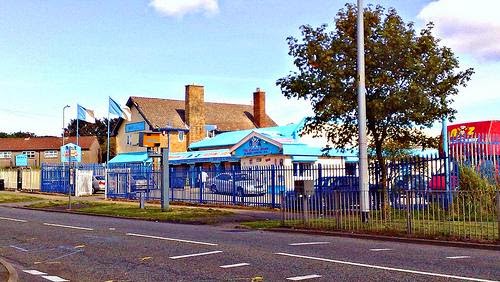
Sett End Road, Shadsworth, Blackburn (circa 2000)
As the stallholders left Sett End's car park on a Saturday afternoon and drove back through Shadsworth, the rave convey would begin to accumulate in the same spot, waiting for directions to the next occupation, be it warehouse or abattoir. I don't see this as an opposition. Instead it seems to me that two homologous economies - both autonomous and independent - used this isolated pub as their base of operations. The fluidity of these activities is a key part of their operations, but there may also be something about the particularity of the sites that also serve to attract such nomadism. Peter Ackroyd talks about certain parts of London (i.e. Clerkenwell) as spaces that maintain their own time zones. When plotting the countercultural map of the north, one might have to account for a similar sense of separation, a distinction borne out of the covert and plural use of certain continually resonant locations. 

*
Much of the history of rave in Blackburn, Altham and the North West is covered in Piers Sanderson's documentary High on Hope. Take a look at the film's website for news of screenings and release dates.

2014/06/08

Horror Story


In the shadow of the recent announcement over at The Haunted Shoreline I came across this grisly story in the Accrington Observer and the Lancashire Evening Telegraph. The synchronicity of one wave receding and then seeing another strange tributary opening up was too speculative an opportunity to miss. Certainly comment might be apt because – to make a suggestion – might one future application of Shoreline’s psychedelic omnivision be in the direction of England’s inland empire: its serpentine network of streams, rivers and canals?


As for the story, it reported the discovery of a dead python in the waters of the Leeds to Liverpool canal. The 10ft carcass was found on the canal’s Huncoat section just a few miles outside of Accrington in Lancashire. The story interested me for a few reasons, not least because I grew up around there and the canal was always a source of strangeness. A body of still water surrounded by coke ovens and empty mills, redundant industry and exhausted fields. Snakes for some reason were also a source of great fear for me and my sister. I didn’t have an actual phobia per se, but snakes and similar creatures always came to mind whenever I thought about monsters or demons. I think it was this image that did it. And this one. And not forgetting this one.

I’ve also been thinking a lot lately about memory and geography; where do we actually go when we think about a specific place, particularly a place that we associate with childhood? Whether the conjuration is positive or negative, this thought-place is inevitably simulacral. It’s a place one builds out of nostalgia, longing or as part of an intentional act of forgetting. Either way, when I saw the snake in the water it precisely summed up the nature of this architecture.  The snake, like the projected place is a creature from the depths. Liminal: neither in nor out. It’s something that floats around in liquid aether and occasionally shows itself. A peculiar combination of myth and matter that’s uncanny insofar as it generates a groundless but nonetheless resonant familiarity, a sense of homecoming and recognition: I have found it, I am here.

The report in the Telegraph hinted at this ambiguity when it quoted RSPCA officer Charlotte Brooker: 

It is obviously an animal that has been kept as a pet and not something that would naturally be found near the canal. It could be that someone has dumped their pet in the canal so as to avoid the charges of disposing of it or it could be something more sinister but we can only speculate at this stage.

Between the ‘obvious’ and the ‘speculative’ there is the ‘sinister’. Sinister is an interesting word. It’s generally used as part of the gothic lexicon of fear and fright like “spooky”. It does denote that which is “suggestive of evil and mischief” but there is a much more specific meaning connected to its role as a mantic signifier. Sinister describes a particular category of omen, one that “portends or indicates misfortune or disaster; full of dark or gloomy suggestiveness; inauspicious, unfavorable”. The word took on this currency because it originally related to a particular type of information, that which is “prompted by malice” and given with “the intent to deceive or mislead”. The link to prophecy comes via the idea that divination involves the reading of signs sent through various natural phenomena. Such occurrences were intuited across the elements including, of course, water. That which is sinister, then, is a bad sign. It is not just that which is frightening but that which is indicative of bad things to come. To describe an object or creature as sinister is to suggest that it exists both here and there. It has not just appeared but has been sent and has broken through. Sinister thus describes exactly the kind of thing we might expect to find in a half-imaginary place of memory and it is precisely the right kind of terms in which to speak of the canal snake.

The Observer also spoke of ‘Horror as remains of 10-foot snake are spotted in canal’. The idea of the snake as an ill-omen could be archetypally linked to myths of serpents crossing paths and fighting at forked roads. As for horror, the discovery clearly connotes this in terms of its overt abjection. However, as with sinister, ‘horror’ also has a more specialized meaning that the resonance of the episode similarly manages to tease out. Horror is a term of sensibility that relates to an experience of shuddering or shivering.  In a leap of metaphor from effect to cause the word also has an obscure sense that describes a shuddering or rippling on the surface of water. As a figure of horror, the found snake encapsulates both of these senses. It is an alien thing that physically troubles the surface of the water, but in so doing also causes a disturbance in the waterways of the imagination. It hints at a cryptozoological depth containing unknown creatures that are potentially physically and philosophically dangerous. This is why The Creature from the Black Lagoon (1954) remains such an effective horror film. The creature can emerge and attack from beneath the surface but at the same the appearance of this pre-historic anomaly disturbs a much wider set of preconceptions relating natural, human and anthropological history.


Lovecraft’s Arkham is full of such things and there are glimpses of similar entities in the streets and factories of David A Riley’s Grudge End. What characterizes these fictional locations is their combination of horror and deep, imagined histories.  Both are also literary conceits that work (at the very least at a genetic level) as superimpositions upon actual territories. Geographical re-imaging is a technique of habituation just as much as it is a device of estrangement, but there is also something both sinister and horrific about such a cathexis, perhaps inevitably so. The conscious or unconscious construction of a place in the memory is an act of cosmogenesis, (the creation of a world or universe) however much it is grounded in geographical specificity. Whilst the boundaries of such a space are potentially vast they are also porous, open to visitation from the outside in as well as the inside out. I’m not sure which side of the door the snake is on.