2016/03/20

Signals from the Future: High Rise Preview Tour


High Rise Live: EV and JR in conversation at the Picturehouse screening
Photo: George Bickers

Last weekend the High Rise preview tour came to the Cambridge Picturehouse. There was to be a special screening plus a post-film Q&A chaired by Evie Salmon. Good stuff. A fortuitous turn of events on the day resulted in me being drafted in to act as the interviewee on the night. I was, of course, more than happy to do this. In fact I was delighted to be asked....

The screening was sold out and after a quick planning conference Evie and I held court on the work of Jeremy Thomas, the unrealized 'ghost' versions of High Rise and hauntological messages from the future. I've added something akin to a transcript below. Many thanks to Evie for the invite and many thanks to the Cambridge Picturehouse for their hospitality. 

EV: High Rise is being touted, rightly so, as another great film from Amy Jump and Ben Wheatley. We'll talk about the Writer / Director team in a moment. Let's just start though by talking about the film's equally distinctive producer, Jeremy Thomas. How do you think High Rise fits in with the rest of his oeuvre

JR: I think it fits very well. In fact I think Jeremy Thomas's signature is all over this. Thomas seems to approach his work as a producer in a manner similar to that of a curator. He seems to commission, as it were, the films he would like to see. He's not unlike the Tony Wilson of independent film. In terms of outlook and attitude, High Rise sits right alongside Thomas's other adaptations of 'difficult', post-1945 works of fiction. He did Naked Lunch with David Cronenberg in 1991 and of course Cronenberg's 'other' J.G. Ballard adaptation Crash in 1996. In 1990 he produced Bernardo Bertolucci's film of The Sheltering Sky (1949) by Paul Bolwes and he also produced David Mackenzie's version of Alexander Trocchi's Young Adam (1954) in 2003. He's done other projects and his portfolio is admirably extensive but there is this consistent return to film projects based on controversial, if not transgressive texts and film projects which help to develop the work of challenging, idiosyncratic directors. On the basis of that modus operandi, doing Ballard's High Rise (1975) with Jump and Wheatley makes complete sense.


Toronto high rise: Cronenberg's Crash (1996) 

Having said that, I would imagine that for Thomas there's quite a degree of personal investment in this particular film. I believe he's held the rights to the novel for the best part of 30 years. There have been at least two other attempts in that time of bringing it to the screen with Thomas as producer. The first was with Nicolas Roeg in the late 1970s. Paul Mayersberg worked on the screenplay after The Man Who Fell to Earth (1976) and Roeg was all set for it before ultimately opting to make Bad Timing (1980), also produced by Thomas. I think Roeg was a good choice for High Rise. Certainly Performance (1970) and Walkabout (1971) both have an emphasis on transformative 'zones' that's not dissimilar to the type of spaces one finds in Ballard. Whatever the reason for it not coming together, let's just pause and imagine what could have been: a version of High Rise by Roeg possibly featuring David Bowie as Royal, Art Garfunkel as Laing and Theresa Russell as Charlotte Melville. I would have liked to have seen that....

The other version I know about was also to have been produced by Thomas with a screenplay by Richard Stanley and directed by Vincenzo Natali. This came up in about 2010. Again, I think this was a very good choice as a creative team. Stanley had dealt with weird events in a tower block in his classic Hardware (1990) and Natali had done brilliant things with ideas of entrapment and enclosure in Cube (1997). A poster emerged for this version and I believe they had opted to re-imagine the novel's London high-rise as the 'Elysium Tower', a contemporary, super-modern residential building in the middle of the sea.   

Vincenzo Natali's High Rise Is A Beautiful Skyscraper Of Doom
Teaser poster from the unrealized High Rise 

EV: Do you think this 'up-dated' version of the film would have worked?

JR: No. Stanley and Natali are brilliant film-makers and I'm sure this would have been an extremely interesting dystopian film, but I don't think it would have been a very accurate J.G. Ballard film. Apparently Thomas pushed a futurological take on the book and there is something prophetic about Ballard's writing. But at the same time he's very much an author of the mid-20th century. High Rise, the novel, is deeply inscribed into its social, economic and material context: Britain in the 1970s. Ballard is, in essence, a science fiction author but he's invariably terrestrial. He's far more interested in inner rather than outer space and his project is to look at the psychopathology of the world, particularly the architecture he sees around him. High Rise is his attack, so to speak, on the material and psychological culture of the 1970s. Its events, scenarios and narrative structure would have to change significantly to set it anywhere (or any-when) else. I just don't think the idea would work in a world of mobile phones, social media, out-sourced private security and total surveillance.

About same time that Stanley was developing High Rise, he was also slated to write and direct another project called Vacation. Vacation featured two American tourists stuck in "a seedy Middle Eastern resort" due to "freak solar storms that eradicate all means of communication". This is purely speculative on my part but I would imagine that to make its scenario half-way feasible this contemporary version of High Rise would have had to involve something similar: somekind of external force or event that causes the building to be cut-off. An interesting idea but not necessarily what Ballard was getting at. This is a long, roundabout way of saying that the main success of Wheatley's version is the fact that it is set specifically in the 1970s. 

EV: In the light of this long gestation then, you're saying that Jeremy Thomas finally found the perfect director in Ben Wheatley? 

JR: I think it certainly makes sense for Wheatley to be making this type of film at this stage in his career. It's the right kind of step-up in terms of budget, cast, exposure etc after films like Kill List (2011) and A Field in England (2013). On a more symbolic level I guess there's what you might call a 'spiritual' inheritance at play with Wheatley making the film. He's on record talking about the influence of Roeg on his own work. At that level its appropriate that he's now taken on and completed Roeg's previously unrealized project. More specifically High Rise fits in very well with Wheatley's ongoing mining of 1970s British culture and what appears to be a developing pre-occupation for dealing with aspects of the British psyche. With A Field in England he looked at aspects of British folklore and Sightseers (2012) analyzed the not-so implicit violence that underwrites the British attitude to the tourist landscape. High Rise shifts focus to urbanism but not without maintaining an emphasis on classic British obsessions: class, manners, status. For all its violence, there's something strangely passive aggressive about both the book and the film. Its savagery comes from the same psychic battlefield covered in the likes of Abigail's Party (1977).
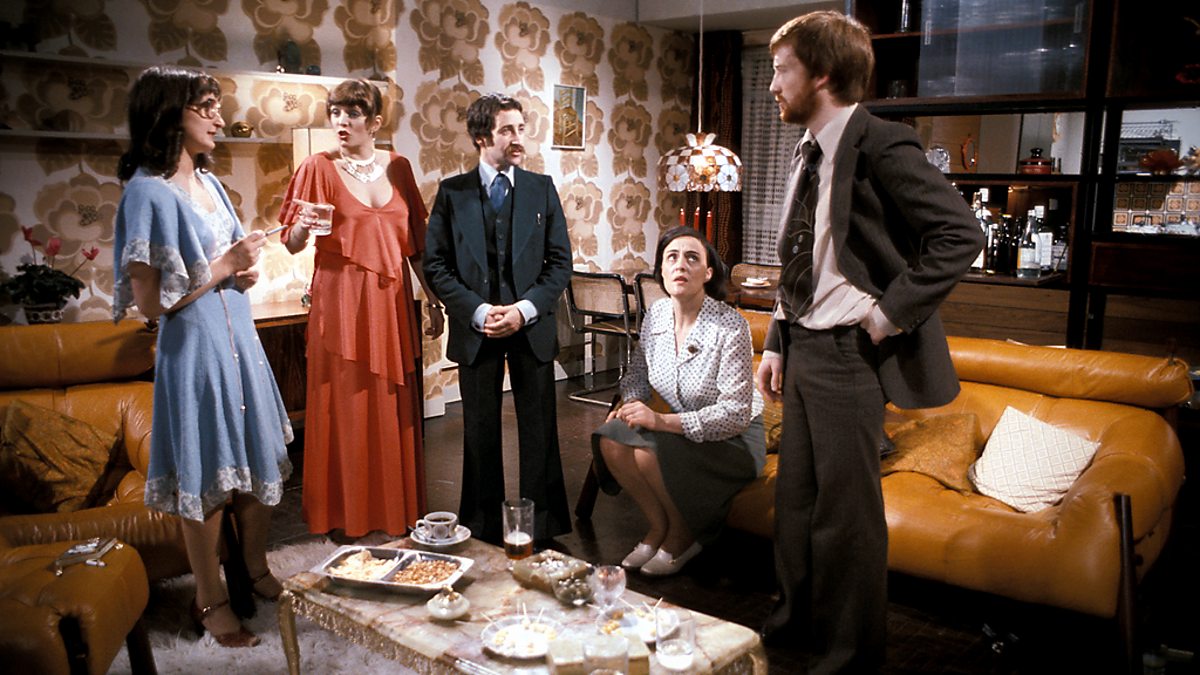
Purgatory: Abigail's Party (1977)

EV: Would you say that Wheatley has come up with a film that's particularly Ballardian?

JR: There are some differences between the novel and Amy Jump's script so, as with any other adaptation, its not totally faithful to the text. That said, I think the film does get the Ballardian sensibility pretty much bang-on. By that I mean Ballard works through a very particular paradigm within his fiction. His concept of inner space is based upon an awareness of a feedback loop between an individual and their built environment. This is one of the primary preoccupations of Ballard's so-called 'Concrete and Steel' trilogy: Crash (1973), Concrete Island (1974) and High Rise. To put it bluntly, in High Rise, Ballard attributes a ambiguous level of agency to the building itself. The events of the novel are not neo-Luddite acts of agitation against architecture but are the results of the building realizing its design. The challenge and difficulty of Ballard's writing lies in accepting these events as things to be welcomed if not actively sought out. When seen in the context of Ballard's wider work it is not intended as 'dystopian'.

This is what separates Ballard from a number of comparable texts. There's Cronenberg's first main feature, Shivers (1975) and John Wagner's Judge Dredd story for 2000AD, 'Block Mania' (1981). In Shivers, a strange parasite infects a luxury apartment block leading to all kinds of psycho-sexual chaos. In 'Block Mania' a two gigantic residential towers go to war. Whilst ostensibly similar to High Rise, both of these scenarios are based on the introduction of something 'other' to an otherwise stable community: a hitherto unknown parasite and water-borne poison. This type of 'alien' entity simply does not exist in High Rise. What Ballard describes can be taken as either an amplification of what's already there in the residents or some other form of response to the corporate stricture. Either way there's something about the building that fascinates Ballard. Wheatley and Jump, I think, make this very clear. It would have been really easy to do a kind of 28 Days Later in a tower block but they wisely focus on the strange attraction and resonances of the building's structure to the extent that it becomes a character. The glimpse we get of Royal's synaptic schematics puts this psychogeographical aspect firmly in the frame. It's very much, as Ballard says in the novel, a case of Laing being "exhilarated by the high rise".
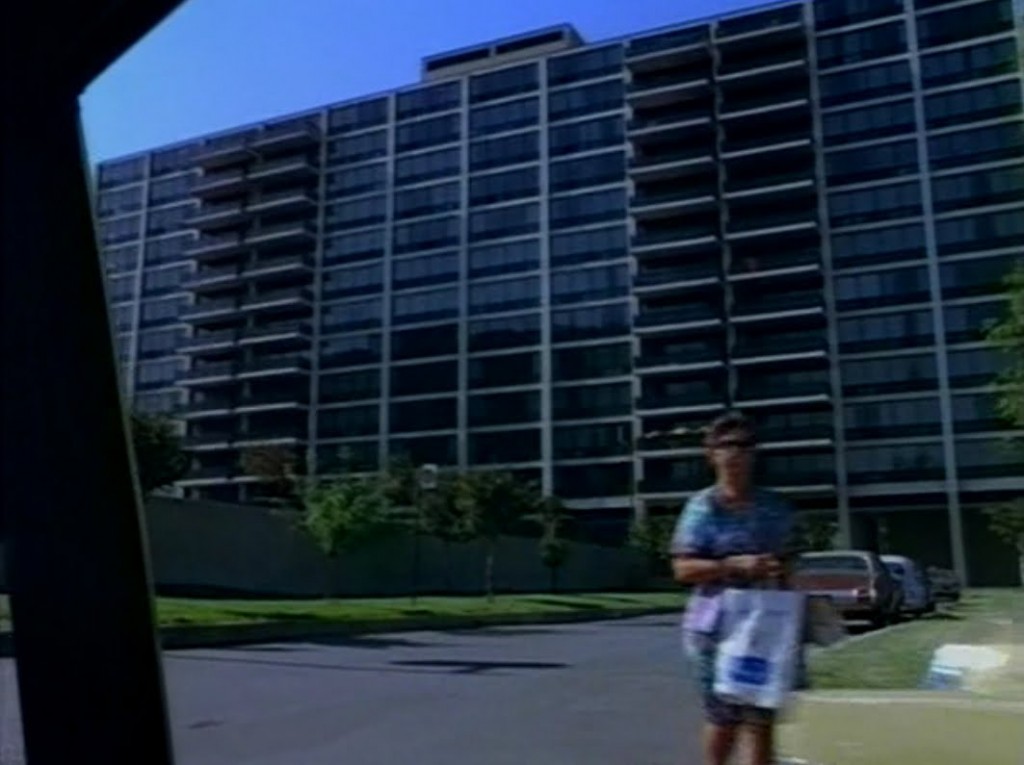
Starliner Towers in Cronenberg's Shivers

EV: We've spoken a lot about Ben Wheatley. I think we need to talk about the other side of this creative process, Amy Jump's excellent screenplay. Clearly, she's absorbed much of the ambience of the novel but as you say, there are some changes. Changes for the better?

JR: The changes make for a better film in these sense that the characters are a little more fleshed out. Ballard basically brings together a series of ciphers and sets them to work in the scenario he builds for the text. They are as hermetic as the building because there's very little in the way of any backstory. In addition to developing characters like the boy Toby, Jump does a good job of giving Laing not so much a pre-history as a little more depth. The scenes of him in the teaching hospital and the way that they feed into an integral subplot add a veneer of complexity to the psychological interactions of the film. There's a sense that Laing has something fermenting before he starts getting involved in the psychotic cocktail parties.

Aside from matters of plot one thing that does change is some aspects of the technological specificity that Ballard makes use of. When Wilder begins to climb the high rise under the auspices of making his documentary he is described as carrying a cine-camera. In the film this becomes an early video camera linked to a portable VCR. Although its far from the most implausible aspect of the film in one sense this is an effective change. Technically a cine-camera would give Wilder only a few minutes of filming time per reel: good for the sleazy bathroom porn that's made in the film but not good for a documentary. But that said, Ballard didn't drop the ball here, he just used references to technology in a different way. Wheatley and Jump use the video camera almost as a non-anachronistic means of Wilder taking a selfie. For Ballard, the whole point was that Wilder would run out of film quickly. This allows Ballard to then describe Wilder brandishing an empty camera as he climbs further up, as if it is a totemic residue of his 'past' life, a bit like the wicker camera in Dennis Hopper's The Last Movie (1971).
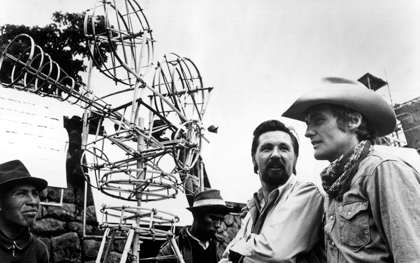

Hopper: The Last Movie (1971) 

EV: I thought the aesthetics of the film were rendered beautifully. It looked great but at the same time was somewhat lo-fi. This seemed to come out not only in the way that the film looked but also how it sounded. I'm thinking in particular of Portishead's version of ABBA's 'SOS' (1975). The song came out in the same year as the novel. Using the contemporary cover allows it to work as a kind of dissonant parallel: historically accurate but at the same time uncanny.

JR: Yes, that's a real high point in the film. It goes hand in hand with the very accurate rendition of the film's entire, enclosed world. Sonically and visually the whole thing feels extremely real: solid. But as you say it's twisted in the direction of an alternative, altered image. For me the dissonance you describe comes out mostly strongly in some of the set design. The interiors of the high rise itself, particularly the corridors, the lobbies and aspects of the tower garden really remind me of a set of buildings in Marseilles designed by Le Corbusier. Known collectively as the Radiant City (1947-1952), they were built according the architectural principles of the unite d'habitation. Essentially this is a philosophy of modernist design that works to establish an invigorating and improving relationship between the inhabitant and their environment. The main block in Marseilles is a fascinating building that works as a type of modernist sun temple. It has long,dark corridors that open out into blazing sun traps. The roof has a wonderful, almost surreal concrete garden. Royal would feel very at home there. The look of the high rise in the film really calls this to mind.

EV: Marseilles is linked to a project of yours I believe?

JR: Yes very much so, thanks for the plug! Along with the writer and poet David Ashford, I'm making a film about the Radiant City and Unite d'habitation. Not a documentary exactly but rather a speculative piece that connects Marseilles to High Rise. Its based around the (fictional) conceit that not only did Ballard take the building as the inspiration for High Rise but that he based the novel as a whole upon a series of events that took place there. One of Ballard's earlier short stories, 'The Thousand Dreams of Stellavista' (1962) uses the device of a 'psychotronic house': a building that responds to the mood of the occupant, records those moods and 'replays' them back in an odd, affective feedback loop. Of course, the interest for Ballard lies in the potential of this structure to record and replay the affective results of a traumatic event to another inhabitant. Our film takes this idea as its central theme and hypothesizes that Le Corbusier's building has somehow absorbed the events of its fictional double, and this information can be accessed by performing of a series of psychogeographic practices in situ. David and I spent a few days there, getting a sense of the atmosphere in the concrete garden, shooting loads of video and generally running up and down the corridors yelling at each other. As ever, its a work in progress but its coming together well. The finished film will use different kinds of video and cine footage to do a kind of High Rise remix: Ballard re-situated in Marseilles and mixed with Le Corbusier's brutalist utopianism.

Still from a work in progress: Unite d'habitation, Marseilles

EV: Towards the end of the film, we see a young boy looking to the air with a home-made radio. We hear Margaret Thatcher's speech to the House of Commons on 24 November 1976 when she was leader of the opposition. Then we hear The Fall's 'Industrial Estate', released in 1979, the year Thatcher comes to power as Prime Minister. So what's this, High Rise as a test bed for Thatcherism? A radio broadcast from the future that breaks into this documentary on urban planning and the problems arising from shared freehold? 

JR: You're absolutely right. I think its precisely those carefully chosen details that prevent the film from being 'just' a 1970s pastiche. It makes the film somewhat hauntological in its politics. The boy tunes into the near future but seen in 2016 it's a mournful futurology: we're invited to lament what this 'future' became.

*

2016/02/28

Review Essays

Cambridge QuarterlyCambridge QuarterlyStudies in Theatre and Performance
       

I've had some recent review essays published in The Cambridge Quarterly and Studies in Theatre and Performance.  I say 'recent' but they actually straddle the last few years. This seems somewhat glacial but academic book circulation, opinion gathering and dissemination works according to its own pace. I was glad to get the chance to read over and comment on Sherryl Vint's Science Fiction: A Guide for the Perplexed, Katy Shaw's David Peace: Texts and Contexts and Rachel Lee Rubin's Well Met: Renaissance Fairs and the American Counterculture. Click the images above for links to the relevant journals.

2016/02/06

Interview with Evie Salmon in Otherzine


Otherzine, the underground film magazine based out of San Francisco's great Other Cinema, have just published their 30th edition. It’s been issued to coincide with Other Cinema's 2016 Spring Programme. Edited by Molly Hankwitz, Otherzine 30: M a T e R i A L Cinema

[…] explores the material processes of film making, whether digital or analogue, small-screen, handmade or multiplex; performed, or projected, performed and projected, historical or recent. We are especially proud of this wonderful and enigmatic collection; clever, individual pieces each a producing a thoughtful glance at or analyzing some component of “materiality” with a very  strong emphasis, as it turns out, upon “live” cinema performance, and the performance of cinema.

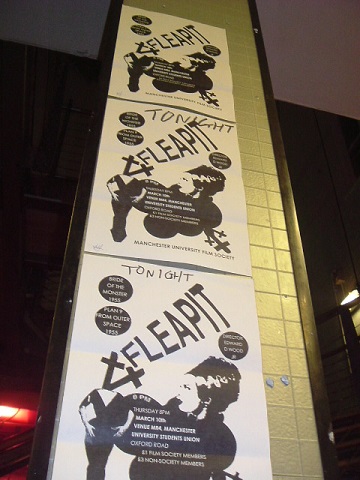
fleapitposters
Fleapit: Somewhere in the North
I’m happy to say that I’ve been included in this issue. The brilliant Evie Salmon graciously took some time out to interview me about Fleapit and the Road Movies project. As you’ll see from the text, because she’s been there since the start, Evie is ideally placed to ask the right kind of questions from the right kind of angle. It was a real pleasure to revisit the very earliest Fleapit shows in this interview which Evie expertly edited from a much longer conversation. Her introduction gets it bang on: shambolic shows, dodgy cowboy boots, disinterested crowds. The battlefield she describes was a brief foray I undertook to Edinburgh just as Fleapit was starting out in Lancaster. An additional point of circularity comes with the link to Other Cinema. Craig Baldwin’s work was a massive influence on Fleapit and continues to inform my thinking on film more generally. As such, it’s a great pleasure to now have the project covered in Otherzine


You can read the issue here. To go to the interview direct, click here

2016/01/06

Ghosts Everywhere

I was back up North recently to do a talk on Gothic writing. During the trip I found myself drawn, drawn, to an area I used to visit as a child: the Accrington – Blackburn stretch of the Leeds and Liverpool Canal. I’ve written about this waterway before. But this particular section, known semi-officially as Cycle Route 6, is the part I had in mind when going on about strange snake appearances.

Cycle Route 6:
complete with raindrops on the video camera lens
This spot marks out something of a borderland between open fields and dense industrial sites. Upstream, the canal moves past a series of small towns and remains largely hidden at their edges. Sometimes it will raise its head at a road bridge but it mainly seems content to meander beside fields and (now more likely) golf courses. But at this point, just before Church Kirk, the canal leaves a wide open expanse and begins to narrow as it moves alongside the flanking walls of Blythe Chemicals. I could make a cheap point and allude to Axis Chemicals from the 1989 Batman film which, to be honest, I always had in mind whenever I passed the factory site. But to draw on such a deliberately blighted image would entirely miss the point. There’s no binary tension here between the industrial and the rural, with the former as some kind of pox upon the latter. It’s easy to place canals with roads and railways as transportation systems that have encroached upon and negatively impacted the landscape. But like hedgerows, dry stone walls and towpaths, the canal represents another form of infrastructural cultivation that has scaped the land over successive generations of its working life, both agricultural and heavy-industrial.

You can see the traces of this intermingling all along the pathway. Before the canal meets the yards at Blythe's, you come across a set of submerged coke ovens: odd, brick igloos once used to carbonize coal. Most of them have been filled in and you can just about see the brick domes undulating under the scrub-land. In the late 1980s and early 90s though, they were much more exposed and lay like pit traps in the ground. I think someone once made the obvious link and used them as the backdrop for a film about the First World War. Part trenches and part mortar craters, they carry the archaeological resonances of the site, much like the imprinted caisson walls in J.G. Ballard’s Empire of the Sun (1987).

Today it’s clear that the canal has moved away from its role in factory trade and transportation, but this specific stretch of waterway is not entirely post-industrial nor is it fully gentrified. Despite the occasional houseboat and despite being implicitly re-branded as a leisure site, Cycle Route 6 doesn’t seem to have fully shaken off the dust of its coal-charging past. It's redundant in the original sense of the word: the waters are still, but it feels active with industrial and chemical energy. Rammed somewhere between a chemical plant and the Nori brick works up at Whinney Hill; crossed with railway lines and in sight of garages and back-street scrap yards, it’s not particularly picturesque, it’s not particularly quiet and it’s always looked stagnant, like something straight out of John Barr’s Derelict Britain (1969). This, of course, is why I like it so much.

The House on the Borderland
I had been reading Susan Hill’s The Woman in Black (1983) ahead of the trip. In addition to understanding the value of a carefully constructed framing device, Hill places her writing well within the tradition of M.R. James and horizontal, landscape gothic. Where James has his East Anglian beaches, Hill transplants wintered Suffolk to the imaginary marshlands of the north east, “a remote corner of England”. Crossing the Nine Lives Causeway to reach the notorious Eel Marsh House, Hills’s narrator Arthur Kipps describes the estuary plain as a space of sublime bleakness:

Today there were no clouds at all, but I could well imagine how magnificently the huge, brooding area of sky would look with grey, scudding rain and storm clouds lowering over the estuary, how it would be here in the floods of February time when the marshes turned to iron-grey and the sky seeped down into them, and in the high winds of March, when the light rippled, shadow chasing shadow across the ploughed fields.

The monochromatic colour-scheme, the rain, the flatness and the sly hints of agriculture and industry: all this matches my impressions of the Accrington-Blackburn canal. It matches my impressions but also, inevitably, my memories, complete with all the fabricated, simulated and nostalgic productivity that accompanies them.

Shortly after this description comes Kipps’s first encounter with Eel Marsh House itself:

It stood like some lighthouse or beacon or martello tower, facing the whole, wide expanse of marsh and estuary, the most astonishingly situated house I had ever seen or could ever have conceivably imagined, isolated, uncompromising but also, I thought, handsome. As we neared it, I saw the land on which it stood was raised up a little, surrounding it on every side for perhaps three or four hundred yards, of plain, salt-bleached grass, and then gravel. This little island extended in a southerly direction across an area of scrub and field towards what looked like the fragmentary ruins of some old church or chapel.

This is James’s preceptory rendered by way of Poe’s House of Usher. The marshland is another “singularly dreary tract of country” where Kipps ‘finds’ himself after travelling “the whole of a dull, dark, and soundless day”. On Route 6 there’s a similar house that stands in the fields on the far side of the canal. It lies parallel with the verge of the railway elevation on a small valley floor. In my mind this tract was an open, barren plateau in which the single house stood as if on a parched island. As a child I remember passing by and feeling something like vertigo. You walk down a path that’s filled with vegetation, but as soon as the tree line breaks, the space opens out to this seemingly vast expanse and there’s this lone anchor embedded in the middle of it. Hill’s ground of “plain salt-bleached grass” brought all this back to me. As with the space she describes in her book, what I remember is an area utterly different from the surrounding fields. Punctuated by the brick domes of the coke ovens and no doubt blasted by years of their exhaust fumes, it felt flat, bleached and drained. There was also this long, serpentine chemical pipe running across the far side like some kind of zonal marker.

Heavy rain
When I went back there the whole place was smaller. It was compact, neat and even. Just a house beyond a fence. I doubt this difference came about due to the shaping and re-shaping of the landscape. In fact, I doubt that my earlier version ever physically existed. So where did it this ‘remembered’ area actually come from in the first place? It feels like an old memory rather than a recently mis-remembered veneer. The combined scene of factories, water and strange dereliction is one that I’ve often imaginatively returned to. And it’s been the connection – emotional, probably – to this set of images that has led me to certain texts, not the other way round. That’s to say, I don’t think reading James et al has embellished this place-memory. I’ve gravitated towards his texts and similar, in part, in order to further extend a type of psychic purchase in the memory of an area that was already heavily embellished.

I like these hinterlands precisely because they carry this generative effect: they prompt ideas and images. My home town and its environs is full of yards, quarries, canal paths and millponds. The train out of Accrington used to pass over all kinds of factory sites with their standing waters, holding areas and stockpiles. It was not unlike flying over an apocalyptic scene. Every time, the response was a series of questions: what is this place? Who works here? What happened here? The resonance they emit has little to do with a ‘past’ or any other original point. Instead, it’s more like a continuing oscillation. Now that the industrial and geographic landscape of Route 6 has changed, I don’t mourn the ‘loss’ of the canal side I knew as a child. I never knew it in this form. The weird vista I’ve had in my head for a couple of decades has always been in there. And I’m happy for it to stay in its dome and to continue to develop in whichever way it wants.

Hill knew all about this internal landscape. Here’s how she described Suffolk in “the Seventies”:

The blackened hull of a rotting boat lay low in the mud. The last geese squawked home in the darkening sky. I sensed ghosts everywhere, looked behind me as I walked faster. There was a strange, steely light glinting, and shadows. Easy to let your imagination run away with you there and the scene stayed with me, though it was another 10 years before I actually made use of it.

She made use of it when composing The Woman in Black. Imaginary Suffolk was transplanted to some indeterminate “corner” as part of Kipps’s journey “North”. Whatever haunted her about her daily walking route had little to do with the land itself. What stayed with her was the germ of the work to come.

2015/12/28

Books of the Year

It's that time again: all and sundry are putting out their end of year polls. To cut through the morass of talking heads taking us through stuff we've already seen, have a look at the 'books of the year posts' over at Wormwoodiana. I'm happy to have been able to contribute along with the fine writers and readers associated with Wormwood.

2015/10/31

Wormwood Article

I have an article in the new issue of Wormwood, the journal of fantastic, supernatural and decadent literature. Titled 'Notes on the Modernist Ghost Story', the essay looks at the various liks between the early 20th century ghost story genre and what might be termed the 'canonical' works of 'high' literary modernism. My thanks go to Mark Valentine for offering me a spot in the issue. I'm deeply indebted also to him for the kind words he posted about the article on the Wormwoodiana blog:

"The ghost story: an old-fashioned form; its finest writer an antiquarian. A thing of graveyards and cloisters, steeped in tradition. Surely it simply “wallows in the nightmares of history”?

Not according to Cambridge academic James Riley, who opens our new issue with his ‘Notes on the Modernist Ghost Story’. It’s time to acknowledge a different approach: 

“…the figure of the ghost, theme of haunting and the presence of the supernatural are not concepts alien to ‘high’ modernism. Woolf opened her collection Monday or Tuesday (1921) with the story ‘A Haunted House’ which later became the title of her posthumous collection A Haunted House and Other Stories in 1944. Consider also Leopold Bloom’s reflections on communication with the dead in Ulysses, and the spectral image of London as an “unreal city” that pervades ‘The Waste Land’. 

"Mary Butts used similar imagery in ‘Mappa Mundi’ (1938) when describing the “matrix” of dream and physical experience that constitutes “Paris and the secret of Paris”. Occupying the ghostly position of that which is there and not there at the same time, the city is compared to the face of Isis glimpsed during an initiation. Similarly, in ‘Mysterious Kȏr’ (1942), Elizabeth Bowen appropriates the fabulous city of H. Rider Haggard’s She (1887) to present wartime London as a “ghost city”."

But his essay doesn’t just broaden our image of the ghost story. James Riley also argues that M R James himself uses modernist concepts, especially in his treatment of time. The distinction between the classic and modernist ghost story may not be reliable."


Wormwoodiana currently features blog posts on each of the articles in the current issue. Check it out for details on essays on Sarban, David Lindsay and Guy Endore. 

2015/09/07

Better Alone: Adam Clitheroe’s One Man in the Band

One Man in the Band poster

"One-man bands. Showmen, eccentrics, loners. This documentary follows a selection of contemporary musicians who play as one-person acts and discovers that, for them, music just sounds so much better when you make it all alone. Featuring musicians from the UK, France and USA and an awesome array of instruments ranging from theremins through to drum machines built from bicycle wheels, the film reveals the struggles that the performers have in balancing their public and private personas. As the music becomes ever more flamboyant and eccentric, so they find themselves retreating into loneliness and solitude. This is a moving and humanistic study of why people choose to be creative, filled with memorable musical performances, and achieving real intimacy between the one-man band filmmaker and his subjects."

One Man in the Band (2008) is one of the great cult music documentaries of recent years. Adam Clitheroe's heroic documentary sheds light on a fascinating musical underworld of sole performers playing on the hinterlands of the live circuit. In addition to featuring great music, it's an unexpected portrait of artistry and isolation. It's also a film that's capable of launching a thousand obsessions. When you see it, you'll find yourself scanning the gig listings, trying to track down some of the performers. The film has just had a digital re-release via Gumroad. Check it out. In the interview below Adam spoke to me about the process of making the film, the people who feature in it and the strange world he was granted acess to.

James Riley: How did the film come together?  
                                                                        
Adam Clitheroe: The film, like many independent projects, arose out of desperation. I'd spent a few years trying to get feature documentaries off the ground. I wasted one summer waiting in fields in Mexico, hoping to meet friendly smugglers. Another time, I went to the Berlin Film Festival for meetings with Nigerian producers, which to my bemusement led to a hard cash offer to make a feature of my choosing. Naturally, the producers went back to Lagos and I never heard from them again. As time went on, the films I was trying to make became smaller and more adaptable to circumstance.      
                                                        
I became interested in making a documentary about performance - the idea that some people are driven to live a life of hard work and abstinent suffering, in return for a few moments of sublimation through performing. It seemed to be the flipside to the 'easy' celebrity culture that was dominating consumer media at the time - the idea that incredibly talented performers were trudging through a long dark winter of the soul, obscure and unremarked yet unwilling to give up on their ambitions. One-man band musicians seemed to be the purest embodiment of this sort of performer. Not novelty buskers, but people who take to the stage alone and compete with conventional bands at their own game, not compromising in the 'full band' sound even though they are solo. Can you name any famous, stadium-filling one-man bands? There are no household names. But there are hundreds of contemporary one-man bands out there working the circuit. Put some of them in a film and you're not going to end up with a celebration of acclaimed musical geniuses, but rather something more democratic: you've not heard any of these artistes, you listen to them and you decide whether or not they are any good.          
                                                 
Man from Uranus
It's obvious to me in retrospect that the subject was attractive because I was wondering if I'd ever make a film again, and whether I should bother. It's being drawn towards that mirror which, when you look into it, you'll be able to say "this is who I am". I hadn't thought about the film much more than that when a music promoter friend introduced me to Man From Uranus in a pub. He's this legendary one-man band, a Gulf War veteran from Florida washed up in the Cambridgeshire countryside who makes deeply eccentric music which sounds like Stockhausen writing kids' TV theme tunes. Plus he plays the theremin while wearing wellington boots on his hands. He invited me to a children's birthday party the next weekend and so the filming began. That's the great thing about the independent music scene - there's a real energy of "don't talk, just do it". On the other hand, independent filmmaking can be paralysed by procrastination - you don't want to piss away years of your life and bankrupt yourself by embarking on the wrong project.

JR: I guess some of these ideas fed into your own 'one man band' filming approach?

AC: Choosing to make the film entirely as a one-man band filmmaker was part of the process of subject and filmmaker finding reflection in one other. I had no funding so my initial worry was that I couldn't afford multiple camera shoots for live music scenes. I figured that if I filmed one-man bands, I would only need one cameraperson - myself. Plus I was very much aware that I had to gain the trust of the musicians in the film - they were allowing me to use their intellectual property of songs and performance. Approaching them as one well-meaning but slightly disorganised filmmaker meant that we found common ground very quickly and could share the chaos together. There is a slight paradox in that most of the one-man bands in the film are quite shy people - they can take the stage and wow a room of people, but strip them of their music and instruments and most of them want to evaporate. It's personal relationships that make interviews possible in these circumstances, and even if I could have afforded a film crew, it would have been a hindrance.

The other influence on the one-man band filmmaking approach was a 16mm short film I made beforehand, called Harder Faster Stronger Stripier. It was about my neighbour, an eccentric painter who is almost an outsider artist. The film was a curious observational piece, a skewed reflection of his world and a space for him to talk on his own terms. I think it had the same combination of the subject's hermetic creativity and idiot gaze of my camerawork that is found in One Man in the Band. It's one of my favourite short films I made. But only four people have seen it. We had the premiere in his front room, it was one of the most successful premieres I have ever had.

JR: How did you decide which artists to focus on?

AC: There are a lot of one-man bands out there, playing every genre of music imaginable. The first challenge is to figure out what you mean by 'one-man band'. It's a catch-all term, but you wouldn't refer to Bob Dylan playing his guitar and harmonica as a one-man band. So is it to do with the number of instruments you play live at the same time, or is someone strumming along to a backing tape also a one-man band? I figured that doing some sort of taxonomy of one-man bands would not make a very interesting film, so for me it became more important to find those people who, in their own minds, are one-man bands. They might not use the actual term, but they think of themselves as full bands and take to the stage to celebrate the joys of noise accordingly.

That principle established, it was a case of hanging out in lots of backstreet gigs and seeing which one-man band performers clicked for me. If you have seen someone play and you have seen something deranged and magical and unique and exciting in what they do, that motivates you to introduce yourself as a filmmaker and persuade them that you have something to offer back. So I guess that the people who made it into the final film were the ones I liked a lot as people and felt a personal connection. The only limiting factor was that some one-man bands are permanently touring and I couldn't afford to keep up with them. I would have loved to put Bob Log III in the film. He's this insanely fast slide guitarist from Arizona who wears an Evel Knievel jumpsuit and a motorcycle helmet with a telephone receiver glued to it. I filmed a gig with him at the Spitz in London and he drove the crowd into a baying mob - incredible. But then he was out of the country the next minute and I had no cash to follow.

One slightly disturbing aspect was that, as shooting progressed, it became clear that the majority of musicians I was filming had very tumultuous personal lives and were in the process of divorcing and separating. I wasn't aware of this beforehand, but when you build this intimate one-on-one relationship with your subject as filmmaker, you become privy to all sorts of personal stuff. Since all this pain and anguish seemed to fall in the brief period for which I was filming, I became worried that I was a bit of a jinx. But really, I think that for some of the musicians, the fact that they were having a rough personal time was subconsciously why I was attracted to filming them. There's this sense of wearing your nerve endings on the surface, of your emotions having been roughly sandpapered, that gives you this peculiar intensity and clarity in the way you present yourself. I don't think it's necessary to be jilted to be a successful one-man band, but that trauma perhaps amplifies certain traits of driven loneliness shared by one-man bands. After all, throwing yourself into your art absorbs the pain of separation.

JR: Could you sketch out some of your working methods? How long did the shooting take? How long did you spend travelling with the artists?

Ninki V
AC: There are seven one-man bands in the film, three from the US, three from the UK and one from France. But I'm based in London which is one of the live music capitals of the world, so I picked up on most of them when they were passing through. I filmed on and off for around six months, for a few days here and there, travelling with them around the UK and in France. I'm not one of those American independent documentary makers who shoots hundreds of hours of footage and then has to employ a story consultant to make sense of the mess. I'm a lazy Englishman who filmed minimally for few evenings and weekends. As I said, I embarked on it with little thought about what the film would be. After I had a few weeks of filming under my belt the paranoia of what the hell was I doing started to kick in. Most of what I had shot had been filmed over a particularly grey and pallid winter, which sort of became an eighth character in the film, so it seemed appropriate to stop before spring kicked in, and to figure out what I had got.

I did try to film the rhythms of life for the one-man bands. Because I didn't have prescriptive ideas I was trying to project into the film, it seemed appropriate to film whatever they were doing when I was with them, regardless of the banality. I didn't want the movie to be a series of highly structured talking head interviews, but then realised I had to interview them a little bit as they were alone on camera and they wouldn't talk at all otherwise. So the film is a series of offbeat chats on location, interspersed with the debris of everyday life. I especially like the scenes with some of the artistes such as Ninki V and Dennis Hopper Choppers in their homes. Someone else's domestic interior is your own vision of insanity.

One of the weird things in the editing of the film was the complete eradication of myself. While shooting, I hadn't really decided whether I would be in or out of the film as an off-camera presence. But because the film in post-production became quite strongly an atmospheric piece, being aware there is always someone else present in the scenes became a distraction. So I faded away and became invisible, like those figures in Soviet history airbrushed out of photographs. All that is left of me is the idiot gaze of that camera and an occasional eccentric spasm of editing.

JR: Man From Uranus seemed to be the fulcrum of the film. Was this because you found him perhaps the most interesting?

AC: Man From Uranus plays a pivotal role in the film. All of the seven musicians are very different personalities and play very different music, ranging from growling blues stomp to hurricane drum solos. But it’s safe to say there's no one else like Man From Uranus in the musical firmament. He plays a range of antiquated analogue electronica from theremin to reel-to-reel, producing a sort of bastardised lounge music on steroids. I think he represents an important aspect of one-man bandship because he's the one who most overtly considers music-making an artform, placing himself in the role of brilliant but odd outsider artist. Indeed, his antics with wellingtons and beep hats make perfect sense as performance art. On top of that, he is incredibly eloquent about his upbringing in the States by libertarian hippies and doom-mongering Baptists and his traumatic experiences in the US military. His musical journey represents some sort of quest for self-worth on his own terms. In the film, he represents the shift from presenting these weird and wonderful one-man bands as entertainers to a more searching questioning of what is it in the human condition that drives some people to be creative. Plus, he's a lovely guy who wears slippers all the time, even in winter snowstorms.

JR: Couple of technical questions: because you were working on your own what was your set up? What type of camera did you use and how did you approach recording the live sound at the concerts you shot?

Duracell
AC: The film was all shot on a handheld progressive scan, square screen DV camera. My background is in 16mm filmmaking, and these video cameras give you results a bit similar to filming on Bolexes. The quality is not brilliant, but it has a texture and fluidity that is right for the subject. Plus you can fling the camera around without worrying about it too much. Portability of camera gear is an important consideration when you're filming a zero budget movie like this. Thomas Truax, a New York one-man band in the film, summarises it well. He builds elaborate mechanical instruments such as the Hornicator and Sister Spinster and uses them as surrogate band members. But if they don't fold up and fit in his suitcase, he can't get them on the train so he can't afford to tour so that's him finished as a solvent musician. Same for filmmaking.

Recording live sound at the concerts was an extreme challenge. Usually there's an array of sound engineers making sure the audio is good for music television, whereas I was on my own, filming, taking stills and getting legal releases all at the same time. I'd turn up with the musicians to sound check, try and persuade the venue sound people to let me have a feed from the mixing desk, and then get another microphone set up in case that sound screwed up during the performance. A lot of these one-man bands are insanely loud... I think it's part of the compensation for being just one person on stage. The French drummer Duracell triggers synth loops from switches around the edges of his drum kit while he drums in the style of Animal from the Muppets. The amplifier he uses was liberated from a Meat Loaf tour in the 70s, and he produces this overwhelming tsunami of noise. The best way for me to get something useable was put a radio clip mic on him and put as many plugs as possible into my own ears so I could get close enough to film.

Having said that, I think it's far better to have the 'raw' music recording in this film than the over-sanitised live music you hear on TV which sounds like it's coming off a CD. Live music should sound live, and as Honkeyfinger said to me after hearing his swamp rock in the film, if it's gnarly that's a good thing. I think it's an important part of the one-man band experience that mistakes and blemishes become part of the performance. There are no other band members to hide behind, it's just you and the audience, and audiences tend to be much more forgiving of errors than they might be for a full band. In the same way, I left a lot of 'blemishes' in the film edit - wildly expressionistic camera zooms, an inexplicable fascination with someone's feet when I should be filming their face. Sometimes it's uncooked filmmaking and it challenges the viewer to accept or reject it. But it's not smug. Smug documentaries suck.

JR: How did you approach the concert shoots? What type of look were you going for?

AC: I never got used to the process of sound checking for the concert, and then spending a few hours in nervous limbo until the performance. Most musicians get tipsy in this downtime and this shared drunkenness became the chief stylistic influence in the concert sequences. Lots of performers have told me that the 'correct' amount of alcohol gives a concert an edge without losing coherence, and I think the same was true for the filming. I found I filmed most of them with a combination of extreme close-ups and extreme wide angles. This is why I always think of the camera as having an idiot, child-like gaze... some of the time marvelling at the bigger picture, other times getting fascinated by an intimate detail such as Two Tears' facial expression of angry euphoria as she sings her nihilist classic 'Shit Fucking Job'.

JR: I found the film strangely decontextualized insofar as apart from one brief reference to "Sheffield" by Thomas Truax and Duracell's drive through France I didn't know where the gigs were taking place. I got the sense of almost directionless travel punctuated with brief concert encounters...was this intentional?

Honkeyfinger
AC: While I was editing the film, I read an interview with Mike Skinner, aka The Streets, in which he said he never mentioned specific locales in his songs because he wants them to appeal to people everywhere. If you have a caption on screen saying "Sheffield, 1am", whether you like it or not, you've focussed your audience's attention on a parochial narrative. If you're depicting an event of global significance, fine, time and date it, but if it's Thomas Truax locked out of his hotel room, don't. I like to think of the film as a frame of mind... it's a way of thinking that exists anywhere, anytime. Plus, the life of a one-man band is seemingly aimless... playing some small venue, packing up and drifting to the next town for the next gig. Identifying this meandering route would glamorise life as having some sort of structure and narrative.

Two of the concert scenes in the film do have a second back-up camera - a twenty quid security camera with a fisheye lens, just to give me a bit of reassurance in case I had a meltdown and filmed complete nonsense with my camera. But all the rest of the film is shot with a solitary gaze. There is actually quite a lot of editing in the music scenes... songs have verses so you can film vocals on one, guitar on another and so on, and edit it together to look like one piece. The audiences are definitely in the background in the concert scenes, loitering in the sepulchral gloom. I wasn't interested in vox popping audience members for what they thought - people watching the documentary can make their own decisions as to whether the music is any good or not. But also, with all the one-man bands I chose to film, I strongly got the impression that they were not playing to pander to the audience, they were playing as part of a personal journey for themselves. They had all reached a stage of musical evolution where, to play their own original compositions, they had moved beyond the possibilities of collaboration. If an audience enjoyed it, that made it even better, but that was not the point. Their music and performance have purity of intention, but with that indefinable atmosphere of oddness that you get when you spend too much time on something by yourself. I think the same can be said of the film.

JR: So given all the hardships and weirdness then, what do you think is the main motivation driving people to do this?

AC: I'd describe the film as a study of why human beings are driven to be creative despite the hardships that life erects in their way. One-man bands are the medium to investigate this idea. And I think the answer is reflected in the form of the film. Life is generally a bland and comforting monotone - in this case, foggy motorways, lukewarm cups of coffee, curmudegeonly cats, hungover loneliness. But every now and then you can break up the greyness with moments of startling, orgasmic intensity - for the one-man bands, the sublimation of hardships into the highs of performance. That's why it's all worthwhile.