Showing posts with label fleapit. Show all posts

2016/02/06

Interview with Evie Salmon in Otherzine


Otherzine, the underground film magazine based out of San Francisco's great Other Cinema, have just published their 30th edition. It’s been issued to coincide with Other Cinema's 2016 Spring Programme. Edited by Molly Hankwitz, Otherzine 30: M a T e R i A L Cinema

[…] explores the material processes of film making, whether digital or analogue, small-screen, handmade or multiplex; performed, or projected, performed and projected, historical or recent. We are especially proud of this wonderful and enigmatic collection; clever, individual pieces each a producing a thoughtful glance at or analyzing some component of “materiality” with a very  strong emphasis, as it turns out, upon “live” cinema performance, and the performance of cinema.

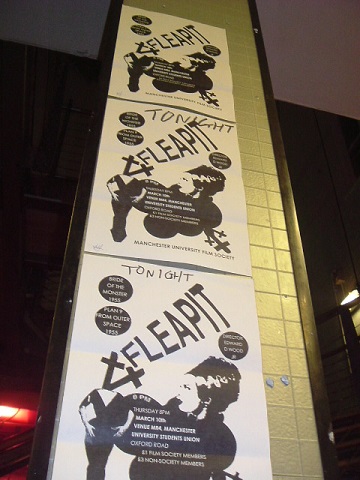
fleapitposters
Fleapit: Somewhere in the North
I’m happy to say that I’ve been included in this issue. The brilliant Evie Salmon graciously took some time out to interview me about Fleapit and the Road Movies project. As you’ll see from the text, because she’s been there since the start, Evie is ideally placed to ask the right kind of questions from the right kind of angle. It was a real pleasure to revisit the very earliest Fleapit shows in this interview which Evie expertly edited from a much longer conversation. Her introduction gets it bang on: shambolic shows, dodgy cowboy boots, disinterested crowds. The battlefield she describes was a brief foray I undertook to Edinburgh just as Fleapit was starting out in Lancaster. An additional point of circularity comes with the link to Other Cinema. Craig Baldwin’s work was a massive influence on Fleapit and continues to inform my thinking on film more generally. As such, it’s a great pleasure to now have the project covered in Otherzine. 


You can read the issue here. To go to the interview direct, click here. 

2015/05/29

Trip Report

Great night at The English Trip event last Wednesday. It was a real pleasure to perform with Evie Salmon alongside English Heretic and Paul Robertson, John Doran and Arabrot. My thanks to those involved, to those who came along and also to all at the Unitarian Church, Cambridge for their hospitality. Scroll down for some images of the night, taken from the church balcony. My camera for some reason doesn't perform well in low, interior light so many thanks indeed to Hannah Gilbert for courageously enduring its operational awkwardness. That said, given the ghostly, hauntological nature of the pieces performed as well as the resonance of the venue, I think the inadvertent ectoplasmic nature of the shots actually works really well. 

As highlighted in previous posts, An English Trip was a Quietus-backed event that featured John Doran reading from his memoir Jolly Lad, backed by noise and dissonance from Arabrot. Doran is touring throughout the whole of May with the intention of scouring England during its election year. This state of the nation-type approach is intended as a version of J.B. Priestley's English Journey (1934) . This was one of the conceptual links with the piece Evie and I performed. We spoke about the psychic landscape of Bradford circa 2010 with particular reference to Stephen Griffiths. Priestley loomed large over this environment, via his film Lost City, but also his 1953 essay for the New Statesman & Nation, 'They Come From Inner Space'. This article pre-dated the extensive use of the term in the mid-1960s by the likes of Alexander Trocchi, J.B. Ballard and Micheal Moorcock. I thought it an appropriate way to link together the various strands of the text: the idea of Griffiths as some kind of emanation of the city; memories of the Fleapit shows staged in Bradford and reflections on the overlaps of film, place and the odd spaces between. Or, as I tried to put it more succinctly during the show, it was a case of thinking about the "blokes [who walk] round their rooms, alone, projecting": 
In 1953 J.B. Priestley set down his thoughts on modern science fiction. Preempting Ballard. Moorcock and the New Worlds crowd by the best part of a decade, he spoke not of “outer space”, but of “inner space”. Science fiction solipsism that that was marked by a willingness on the part of the authors to consider altered states, strange perceptions and the effects of the exterior world upon the interior. Priestley, Bradford’s favorite son, was well placed to make such a speculation. He would have known just how much the genes are woven out of a given locality. He would have known how much a town gives rise to the voice, the walk and the gesture; how small the distances are that we really travel in life. Making one’s mark is not so much an act of graffiti as a signature on a pre-drafted contract. The uncanny is only ever a means of making us feel more at home. 
It was interesting to see the extent to which each of the pieces reflected on aspects of the North. In addition to Doran's descriptions of growing up in Merseyside, English Heretic's brilliant 'Video Anxieties' looked at the Peak Distinct, Dovedale and The Living Dead at the Manchester Morgue. Churches played key roles in each set which, on reflection, helped to reinforce the 'seance' atmosphere of the evening: readings in one sacred space helped to channel memories of past events in other sacred spaces. More specifically, the point of conceptual connection between 'Psycho / Geography' and 'Video Anxieties' was James Anderton, the figure who links Yorkshire, the Yorkshire Ripper and video horror. As English Heretic writes in 'Video Anxieties' in Sepul Culture: The Underworld Service Guide Book, 
2014 marks the 20th anniversary of the infamous Video Recordings Act. Instigated by Yorkshire Ripper suspect, DC James Anderton, it's ironic that Living Dead at the Manchester Morgue constitutes one of the few videos actually filmed in England. Anderton himself, of course, was Manchester's avenging right wing Christian crime fighter. Perhaps he thought the zombies constituted a threat to his home city. Anderton, like the Yorkshire Ripper claimed to hear the voice of God: reality was not his closest companion.
May 2015 is also the 5th anniversary of Griffiths' arrest. I think we were both trying to get at the accumulated syncronicities inscribed into these already entangled meetings of place, film and extreme experience.

Images

Some suitably spectral and mysterious images from the English Trip event. Many thanks to Hannah Gilbert for taking charge of the camera.

The set up at the Unitarian Church
English Heretic introducing James Riley and Evie Salmon
Psycho / Geography underway
Starting to blur
The seance voice
JR and John Doran 
EV

2015/05/26

English Tripping

Poster for the Cambridge leg of the English Trip tour

Ahead of tomorrow night's event, here are some links of interest: 

As mentioned in previous posts, I'll be presenting 'Psycho / Geography', a spoken word set with Evie Salmon: 


Psycho / Geography is an experimental lecture for two voices. Using half-remembered anecdotes, strange visuals and the pages of true crime paperbacks James Riley and Evie Salmon will recount a bad trip to through Bradford and the psychic territory of Stephen Griffiths, the Crossbow Cannibal. Based on Riley’s eccentric journeys at the helm of a travelling microcinema, Psycho / Geography is one part travelogue and one part spurious celebration of cult film.

2015/04/15

An English Trip


In May I'll be taking part in An English Trip, John Doran's Quietus-backed tour to coincide with the publication of his book A Jolly Lad. I'll be doing a spoken-word set with Evie Salmon based on a road trip to Bradford. It'll be a mix of material from Road Movies and The Bad Trip: part travelogue, part spurious celebration of cult film. A psychogeographic mash-up of half-remembered anecdotes and true-crime paperbacks.   

I've seen John read before and he puts on a good show. The gig has been co-ordinated by English Heretic who will also be performing. Very excited to be part of this....

For venue and ticket information go to the English Trip Facebook page. You can also read a good interview / article with John about the book and the tour over at The Quietus. 

2015/02/09

Road Movies / Screen Media

Last week, as part of the ongoing Road Movies project, I did a talk about Fleapit, cult film and associated ideas at the Screen Media Research Seminar in Cambridge. Abstract below. Thanks to those who came along and thanks to Rhiannon, Emma and Evie for setting it up. 


* 

Road Movies: Projection, DIY Cinema and Cult Film. 

Between 2003 and 2009 I ran a microcinema from the back of my car. The programme offered focused exclusively on works of cult film and ‘para-cinema’ and the screenings were staged in small, ‘unofficial’ venues: cellars, bars, kitchens, classrooms, front rooms and bomb shelters. 

These events began, in part, as acts of practical research into the connection between projection and place: venues were chosen for the purposes of creating something of a dialogue with the film (or more specifically, video) that was shown. Over the course of six years the project grew and assumed an increasingly mobile format. This involved the production of screenings at festivals, raves and academic conferences. Two nationwide tours of the UK were also undertaken which saw screenings mounted in nightclubs, in museums and alongside various live bands. 

A basement show during the 2005 Fleapit tour

In this talk, I will discuss the screening project in more detail and expand upon some of its theoretical aspects. Reference will be made to a wider context of ‘underground’ (sometimes literally underground) film exhibition that the project drew upon and participated in. In keeping with the forms of practice discussed and the approach of the book that the project now feeds into, sections of the talk will be intentionally autobiographical and speculative. One aim will be to map the cultural terrain inhabited by the events considered, a territory in which image projection elides into forms of psychological projection.

2014/07/03

Occult, Magick, Evil and the Powers of Horror

The new issue of One+One is out and you can read it here. It's a special edition covering 'Occult, Magick, Evil and the Powers of Horror'. I have two articles included, one on projection and Night of the Demon, the other on Craig Baldwin and his film Mock-Up on Mu. Mark Goodall also has an article on Mario Mercier which is well worth checking out.....

Many thanks to James Marcus Tucker, Bradley Tuck and the rest of the One+One team for pulling this issue together.....

2013/12/17

Fleapit Article

Film journal One+One have just published their latest issue, the second volume of their special edition focusing on trash, exploitation and cult cinema.  I've written an article for volume two, 'White Walls and Empty Rooms: A Short History of the Fleapit'. This looks at the culture of underground film exhibition and also provides a brief account of the 'Fleapit' screening group I ran between 2003 and 2009.


Fleapit is the topic of Road Movies and this article works as something of a primer for that project.   

2013/09/09

LA X-Ray

Roger Corman’s X: The Man with the X-Ray Eyes (1963) has had a strange afterlife. It’s not as popular as The Little Shop of Horrors (1960) or Corman’s Poesploitation oeuvre, but for sheer hallucinatory energy it’s certainly a lot better than his overrated LSD movie The Trip (1967). Corman says more about his other films in How I Made a Hundred Movies in Hollywood (1998) but X has nevertheless persisted as a “cult creepie” not least because of its appropriation by contemporary film-makers particularly Amanda Beech and Craig Baldwin.

X ostensibly keys into all the comic-book phantasies promised by 25-cent x-ray specs. Ray Milland stars as James Xavier, the archetypal scientific over-reacher who, frustrated with his limited perception of the wave spectrum, self-administers the experimental Compound X. This grants him the power to see through walls and clothes as well as the ability to assess and intervene in risky surgical practices. So far, so good – nothing particularly interesting here. However, once Xavier realises that Compound X is cumulative in its effects, the film takes on an unexpected level of proto-psychedelic intensity. He’s robbed of darkness, sleep, shelter from the glare of the sun until finally, wandering in the desert on the outer limits of Las Vegas, he confronts the terminal horror of the universe fully revealed.

X belongs to Corman’s subset of nihilistic, eschatological movies, films like The Day the World Ended (1955) and The Last Woman on Earth (1960). Whereas films like It Conquered the World (1956) mirror the paranoia of Invasion of the Body Snatchers (1956), these films are full of Cold war fear and loathing: not the anxiety that something awful might happen, but the dread and ennui that comes with having living through the actuality of such a disaster. Although X doesn’t take place on a ruined Earth, it nonetheless plots a (literally) post-apocalyptic scenario because it shows the immolating consequences that follow a moment of intense revelation.

Part of what makes X interesting is its reliance on the structure of the road movie. Xavier moves from downtown LA to the wastelands of the desert; from urban rationality to the hysteria of an evangelical tent-meeting and his final epiphany. Along the way he sees Los Angeles as an x-rayed accumulation of skeletal architecture, a “city unborn, with its skin dissolved in an acid of light […] a city of the dead”.

That Xavier is able to perceive the scaffold that underpins the svelte exterior of Los Angeles and later, Las Vegas, gives his x-ray vision a critical trajectory. At the start of the film, Xavier’s exploration of the wave spectrum is epistemological. It provides a means of discovery as regards the spaces that carry sedimentary content. Walls are seen to enclose rooms that hold private dramas and clothes cover bodies that carry organs held in place by skeletons. By the time of his urban excursions, Xavier’s insight has become ontological. He is able to see that which constitutes the material – and in the film’s closing moments the phenomenological – fabric of ‘reality’. His view of LA as the “unborn” city “rising in the sky” full of “signs without supports” announces a paradigmatic shift in the trajectory of his vision. An awareness of architectural and corporeal dissimulation gives rise to a perception of these surfaces as simulations, membranes of false plenitude that cover abysmal vacancy.

Beech draws on this aspect of X in her multi-platform work Sanity Assassin (2010). Commissioned by Spike Island in Bristol, Sanity Assassin is a three-channel video installation that incorporates a “sculptural [1] element: a spotlit mirrored plinth which displays a series of polished chainsaws situated in a custom-designed waiting area”.

The ‘showroom’ is based on the premises of the McCulloch chainsaw company in LA and the parallel video depicts a series of cityscape scenes cut to a noise soundtrack and a draconian editing rhythm.

Sanity Assassin offers Los Angeles as a geographical ossification of the neo-liberal agenda. Reality is presented a particularly violent form of hegemonic realism whereby space, policy and capital maintain dominance (despite inefficiency) through the projection of freedom and security as non-contradictory utopian ideals. Mike Davis offered a similar critique of LA’s political architecture in City of Quartz (1990) in which he analysed such late-capitalist symptoms as the city’s ‘fortress’ aesthetic and its gentrifying public transport facilities.[2] By contrast, Beech’s work draws this critical identification of postmodern irony into its analysis. Sanity Assassin works to interrogate the process of critique. Her study of LA operates as part of a wider investigative field in which the humanistic bias of critical theory is positioned as an agent in the production of the politics it seeks to question: “exposing power and making it visible simply reminds us that power exists as such”.[3] In the light of this position, Sanity Assassin takes as its representational modus operandi the contingency of power:

The work explores the various contradictions that are produced as a consequence of theorizing how to act when there is no absolute power to target and no centre from which to operate. Most particularly, the work attempted to explore the aestheticization and theorization of this infinitude as the real of the political and how it informs and shapes politics.[4]

In Sanity Assassin, the book that accompanies the installation, Beech includes a series of research images that informed the composition of the work. Amongst this montage of interiors and monoliths there’s a small still of Milland as Xavier taken from the closing moments of Corman’s film. Gazing with obsidian eyes into the agony of the revealed void, attempting to comprehend “the eye that watches us all”, Xavier exemplifies Beech’s project. As Marie-Anne McQuay suggests, the “horrific consequences” of Xavier’s “collision with the Real” signpost the trajectory of the project towards the interrogation and removal of the anthropomorphic subject in the work of critique.[5] By aligning Xavier’s vision with the Real, “the umbilical cord of the symbolic”[6], the subject of his gaze is recast not as that which is ‘beneath’ or ‘beyond’ but that which is negative; the sense of difference rather than correspondence that normative perceptions work to exclude. What the film couches in terms of sin and transgression is presented in Sanity Assassin as momentary proximity with the kind of conceptual heat that closes Robert Aldrich’s Kiss Me Deadly (1955).

The oscillation in X between the physical and the metaphysical evokes the “cult stratum” that Davis highlights in the rise of Southern California as a science state. From the mid-1920s, the California Institute of Technology in Pasadena played host to a rolling faculty of pioneering scientists who helped to establish “an emergent techno-structure” that fueled a post-war science based economy.[7] However, in the case of John ‘Jack’ Whiteside Parsons, this intellectual labour intersected with a dense matrix of seemingly dissonant interests. 

Parsons was a key influence in the establishment of the Pasadena Jet propulsion Laboratory and contributed to the development of solid rocket fuel. He was also a student of the occult and in 1942, under the guidance of Aleister Crowley, he assumed leadership of the Agape Lodge of the Ordo Templi Orientis (OTO). In addition, he was a member of the Los Angeles Fantasy and Science Fiction Society where he met Robert Heinlein and L. Ron Hubbard. His association with Heinlein gave the latter important pointers for Stranger in a Strange Land (1961) whilst his ill-fated connection to Hubbard arguably informed the “amalgamation of black magic, psychotherapy and science fiction” that Hubbard peddled as Scientology.[8]

In Davis’ discussion, this web of connections that move across the “vast wheel of public-private research” represent “bizarre” detours in the otherwise “seamless continuum between the corporation, laboratory and classroom” that characterised the economic rise of post-war Southern California. Certainly in the case of the ascent of Dianetics and Scientology, the persistence of this distant Cal-Tech offspring exists as a “discouraging reminder of science’s fate in the local culture”.[9]  For San-Franciscan film-maker Craig Baldwinthis web is not a historical aberration but is instead representative of the actual matter of Southern California. The “local culture” is entirely constituted of these spirals of conspiracy, post-war science, espionage and ‘trash’ aesthetics.

In his film, Mock-Up on Mu (2008) Baldwin embarks upon a similar excavation of Southern California’s Mock-Up on Mu is a speculative analysis of the biographical intersections that existed between L.Ron Hubbard, Aleister Crowley, Jack Parsons, Marjorie Cameron and Lockheed Martin. In essence, this group symbolises the same triangle of culture, science and industry central to Davis’ analysis. However, Baldwin’s collage approach – the creation of a ‘documentary’ using clips from obscure b-movies and ‘found footage’ – seeks not to pull away the veils of myth in order to foreground ‘truth’ but instead exaggerates the imaginary lives of the characters as a means to analyse the construction of the myth.
future as that performed by Davis, but rather than analysing the concrete terrain of significant structures, he explores the imaginary environment of genre cinema and mythopoesis.

Within this approach, X plays a small but significant role. Corman’s film is one of the many that Baldwin absorbs into his cut-up network that structures the film. In Chapter 11, ‘Desert Crossings: A fugitive Parsons sets off a manhunt’, we see Parsons, (played by Kal Spelletich) fleeing across the desert having been shot by Lockheed Martin (Stoney Burke) as part of a wider Hubbard engineered plot to gain control of a solar energy device. Parsons’ flight is inter-cut with that of Cary Grant in North by Northwest (1959) and Milland in X. Over the top of this montage Baldwin adds a voice-over that reads from Parsons’ essay ‘Freedom is a Two-Edged Sword’ (1950): 

The inertia and acquiescence which allows the suspension of our liberties would once have been unthinkable. The present ignorance and indifference is appalling. The little that is worthwhile in our civilization and culture is made possible by the few who are capable of creative thinking and independent action, grudgingly assisted by the rest. When the majority of men surrender their freedom, barbarism is near but when the creative minority surrender it, the Dark Age has arrived. Even the word liberalism has now become a front for a new social form of Christian morality. Science, that was going to save the world back in H.G. Wells' time, is regimented, straitjacketed and scared; its universal language is diminished to one word, security.[10]

‘Freedom’ is essentially a libertarian tract that posits the concept as the product of self-ultimacy, whereby the exertion of the individual will can help cultivate the appropriate territory in which “man” can live. However, in the quote above its hard not to see some echoes of Beech’s project. Putting aside the implied desire for an Ayn Randian creative oligarchy, the connection of “liberalism” with the restrictions of “security” evokes the critique of neo-liberalism and the security state in Sanity Assassin.

Baldwin’s use of X is also similar. Ostensibly the montage seeks to equate Parsons’ near death pursuit of a Temporary Autonomous Zone with the transcendent vision of Xavier. Both appear to willfully strive for an apprehension of a space or entity that lies beyond normative limits. However, this Nietzschean individualism is subverted through the proliferation that Baldwin creates via the application of his assemblage technique. Despite the self-assertion of Parsons’ words, at the level of the image, ‘Parsons’ is a fluid persona, one the drifts from the actor Spelletich to any number of substitutes: Milland, Grant and elsewhere in the film Kris Kristopherson and Hugh Marlowe The character thus holds no stable subjectivity. Instead, there is only a strange kind of dub identity, one that constantly navigates the length of a wave spectrum from reconstructive performance to speculative association. If X represents the horror of the LA Real in Sanity Assassin, in the matrix of Mock-Up on Mu, the stroboscopic expanse that forms the narrative of Corman’s film offers a complimentary metaphor. Baldwin’s conspiratorial web gives no glimpse of an occulted ‘reality’ but offers the networks of conspiracy as the Real that informs the symbolic structure of his obsessive characters.  


[1] Marie-Anne McQuay,‘Introduction’ in Sanity Assassin (Falmouth: Urbanomic, 2010), pp. 7-11 (p.7).
[2] Mike Davis, City of Quartz: Excavating the Future in Los Angeles (London: Verso, 1990), pp.223-263.
[3] Amanda Beech and Jaspar Joseph-Lester, ‘Reason Without Reason’, in Sanity Assassin, p.92.
[4] Ibid.
[5] Beech, p.66; McQuay, p. 8.
[6] Alan Sheridan in Jacques Lacan, The Four Fundamental Concepts of Psychoanalysis, (Harmondsworth: Penguin, 1973), p. 279.
[7] Davis, p. 59.
[8] Ibid, p.60.
[9] Ibid.
[10] John Whiteside Parsons, ‘Freedom Is a Two Edged Sword’ in Freedom Is a Two Edged Sword and Other Essays (USA: New Falcon, 2001).